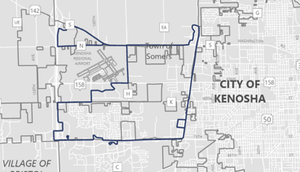



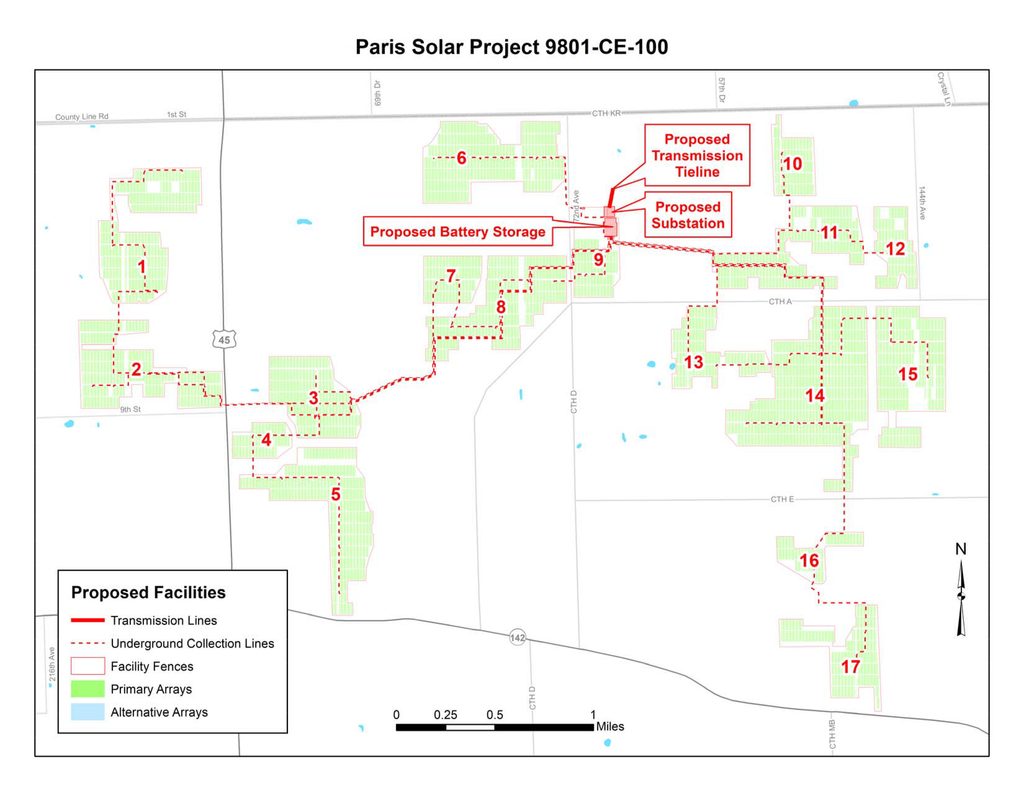
PARIS, Wis. — A massive solar and battery storage project in the Town of Paris, Kenosha County, has exceeded its originally approved $433 million price tag by nearly 40%, and Wisconsin utility customers will be responsible for paying the higher costs. The Wisconsin Public Service Commission (PSC) voted November 5, 2026, to allow We Energies to recover the costs of the Paris Solar-Battery Park from ratepayers, although commissioners prohibited the utility from earning a shareholder return on $166 million in spending that exceeded previously authorized amounts.

The project, developed by Invenergy and acquired by We Energies, Wisconsin Public Service Corporation (WPS), and Madison Gas and Electric (MGE), consists of approximately 200 megawatts of solar generation and 110 megawatts of battery storage. Approximately 1,500 acres of land in the Town of Paris were designated for development within a larger project area encompassing more than 5,000 acres.

The PSC approved the utilities’ acquisition of the project in 2022 at an estimated cost of $433 million. However, by the time the solar facility began operating in December 2024 and the battery storage system followed in June 2025, the project’s costs had climbed significantly beyond the amount regulators originally authorized.

The financial controversy came to a head during the PSC’s November 5 meeting, when commissioners examined whether utility customers should be required to pay for spending that consumer advocates argued had not been adequately justified. Although the commission allowed recovery of the full costs, it determined that We Energies could not earn a shareholder return on $166 million in previously unapproved spending, according to reporting by Wisconsin Watch.

The distinction is significant. While the decision prevents the utility from collecting additional profits on the disputed portion of its investment, customers will still be responsible for repaying the underlying project costs through their electric rates.

Documents obtained and reviewed by Kenosha County Eye reveal that the dispute involved more than ordinary construction expenses. The PSC’s 274-page October 21 decision matrix, filed under docket 5-UR-112, details disagreements between We Energies, state regulatory staff, and consumer advocates about whether the utility adequately explained and disclosed the escalating costs.

Commission staff noted that some of the increases appeared generally consistent with rising costs throughout the solar and battery storage industry. However, staff also determined that We Energies had not provided sufficient quantitative evidence to substantiate its explanations for the increases or demonstrate the effectiveness of its efforts to control expenses.

The Citizens Utility Board (CUB), an organization representing utility customers, took an even stronger position. CUB argued that the Paris project’s costs exceeded both the amounts the commission had authorized and broader industry-wide cost increases, and that We Energies had failed to provide timely disclosure of the mounting expenses.
CUB urged commissioners to reject the overruns entirely, reduce the amount recoverable from customers, or at a minimum prohibit the utility from earning a shareholder return on the additional spending. Its position was documented in Issue 23 of the PSC’s decision matrix, which specifically addressed whether the Paris Solar and Battery Energy Storage System overruns should be included in the utility’s 2027 and 2028 revenue requirements.
We Energies disputed those arguments, maintaining that the increased costs resulted largely from circumstances beyond its control. The utility cited global supply-chain disruptions following the COVID-19 pandemic, labor shortages, and additional costs associated with federal restrictions intended to prevent solar products made with forced labor from entering the United States.
The company also argued that it had taken reasonable steps to limit expenses, including delaying certain construction contracts until prices stabilized, reallocating labor, and negotiating a settlement involving solar panels. We Energies maintained that cost overruns do not automatically establish that a utility acted imprudently.
One commissioner, however, was particularly critical of the utility’s handling of the project.
PSC Commissioner Marcus Hawkins questioned why We Energies had failed to adequately account for risks that were already known when the utility sought approval to purchase the project. According to Wisconsin Watch, Hawkins criticized the utility for disregarding those risks while leaving customers exposed to unexpected expenses.
The commissioner emphasized the importance of imposing financial consequences when utilities fail to adequately disclose or manage significant construction-cost increases. The decision to deny shareholder returns on the $166 million was intended to discourage similar conduct in future projects. Wisconsin Watch
The PSC’s October decision matrix also identified the potential effect of allowing the Paris project’s cost overruns into the utility’s future rate calculations. Commission staff estimated that including those expenses would increase We Energies’ annual electric revenue requirements by approximately $13.5 million in 2027 and $13.2 million in 2028, compared with calculations excluding the disputed costs.
Those figures represent projected annual revenue-requirement impacts under the assumptions presented before the commission’s November 5 vote, not the total amount by which the project exceeded its budget. The precise treatment of the costs and their ultimate effect on individual customer bills will be reflected in the PSC’s final written order.
The controversy comes as Wisconsin communities grapple with an expanding number of large-scale energy projects, including several controversial proposals in Kenosha County.
Kenosha County Eye has extensively covered the proposed 200-megawatt Robin Energy Storage battery facility in Wheatland, where residents have raised concerns about local control, transparency, land use, and the authority of state regulators to approve projects despite municipal opposition. The proposed Red Oak Ridge natural gas-fired power plant in the Paris area has also generated significant public scrutiny.
Although these are separate projects, they raise broader questions about how much influence local residents should have over energy infrastructure proposed for their communities and how financial risks are ultimately divided between utility companies and their customers.
The Paris Solar-Battery Park dispute also illustrates a distinction in Wisconsin’s regulatory process. When the PSC initially approved construction of the project, it was being developed by an independent power producer, meaning regulators did not evaluate the project’s necessity or construction costs in the same manner as a utility-owned facility.
The PSC’s own project description explains that the financial effects on Wisconsin utilities and their customers would be reviewed when those utilities purchased the project or its electricity. The subsequent acquisition and rate proceedings ultimately placed the escalating costs before regulators. Public Service Commission of Wisconsin
The November 5 proceedings also resulted in a reduction of We Energies’ overall requested rate increases. Commissioners approved an electric rate increase of approximately 7% spread across 2027 and 2028, smaller than the approximately 9% overall increase the utility had initially sought.
Even with those reductions, customers are expected to see higher electric bills over the next two years. According to Wisconsin Watch, We Energies estimated that the average residential customer’s monthly bill would increase by approximately $7 to $8 in 2027 and another $6 to $7 in 2028. Those increases reflect the broader rate case and cannot be attributed solely to Paris Solar. Wisconsin Watch
The Paris Solar project is not the only major renewable energy development facing questions about construction costs. The PSC is also expected to revisit substantial overruns involving the Darien Solar Energy Center in Rock and Walworth counties and the Koshkonong Solar Energy Center in Dane County, where costs reportedly exceed previously approved amounts by 35% and 42%, respectively.
Those projects remain subject to additional regulatory review because their facilities were not yet fully operational when commissioners considered the November rate case. The commission’s treatment of those overruns could establish further limits on what Wisconsin utilities may recover from customers when large infrastructure projects exceed their approved budgets.
For now, the Paris Solar-Battery Park decision leaves Wisconsin utility customers paying for a project that ultimately cost substantially more than originally anticipated, while limiting the financial return available to We Energies on $166 million in disputed spending.
The PSC’s final written order detailing the November 5 decisions had not yet been identified in the publicly available records reviewed by Kenosha County Eye. The underlying proceedings can be examined through PSC dockets 9801-CE-100, 5-BS-254, and 5-UR-112, including the decision matrix filed as PSC Reference No. 615667.
The controversy raises an important question as Wisconsin prepares for additional energy development: When a utility-backed project runs dramatically over budget, how much of the financial responsibility should fall on the company’s shareholders, and how much should be passed along to the customers who had no say in approving the additional spending?