



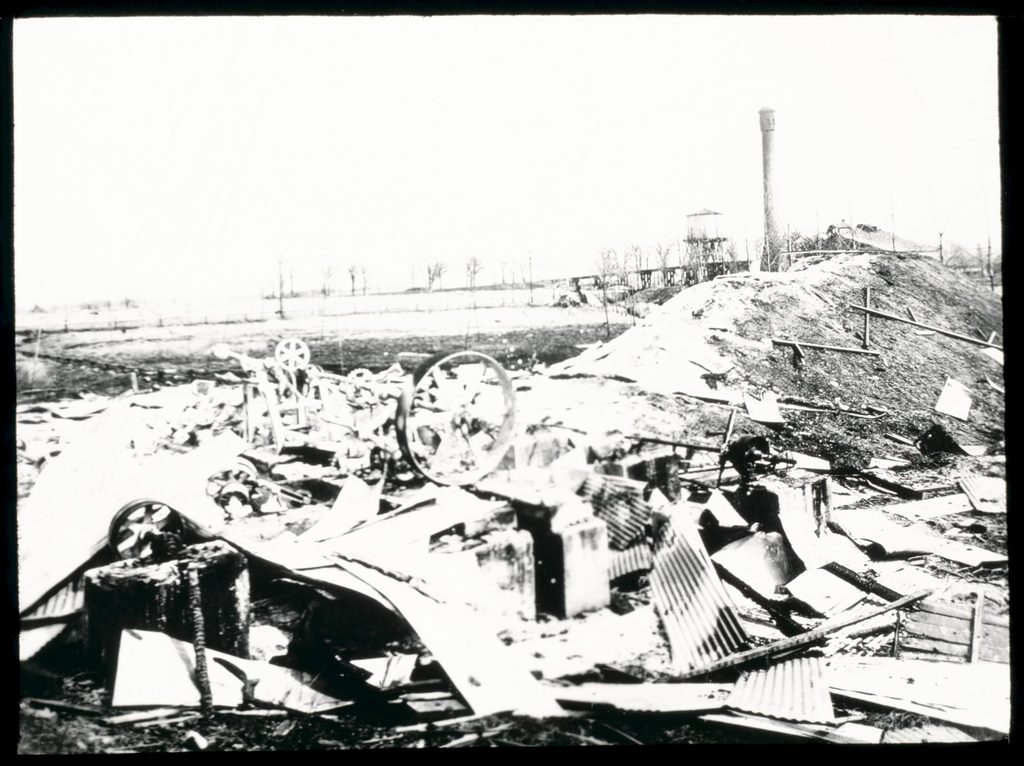
PLEASANT PRAIRIE, Wis. — The U.S. Army’s controlled destruction of nearly five tons of unstable explosives in Iowa Wednesday brought renewed attention to a devastating chapter in Kenosha County history: the March 9, 1911, powder-plant explosion that wrecked buildings in Pleasant Prairie and shattered windows as far away as Chicago. More than 115 years later, photographs and contemporary newspaper accounts preserve the destruction and fear that followed the nighttime disaster.

Wednesday’s detonation occurred at approximately 9 a.m. at the Iowa Army Ammunition Plant in Middletown. Army officials said the operation successfully destroyed the degraded lead azide without secondary explosions or infrastructure damage, while initial EPA monitoring detected no airborne lead around the installation.

The Army said approximately 68 drums containing more than 9,700 pounds of explosives had deteriorated and developed highly sensitive crystals. Officials concluded that moving or otherwise handling the material presented an unacceptable risk and chose to destroy it where it was stored.

Crews surrounded the Iowa storage structures with extensive protective measures, including sand-filled barriers, water, gel blocks and foam intended to limit the blast’s effects and the spread of lead particles. Federal agencies also arranged environmental sampling and recommended temporary relocation for residents in the affected area ahead of the operation.

Pleasant Prairie residents in 1911 experienced their explosion without such advance preparations. Shortly after 8 p.m. on Thursday, March 9, a series of blasts tore through the Laflin & Rand powder works, then under DuPont control, and fire swept across the property.

A photograph preserved by the Kenosha History Center and digitized by UW–Madison shows a wrecked factory building, ruined machinery and scattered debris. Its accompanying description states that within five minutes of the first explosion, the plant was engulfed in flames.

The approximately 190-acre industrial property was located in the Des Plaines River basin, east of present-day I-94 and south of Highway 50. A village historical account describes widespread damage to nearby homes and farms, with numerous residents injured and plant employee E. S. Thompson killed.

The same account, published in 2014, reported that remnants of the operation remained on private property. One resident clearing brush discovered a large stone structure and concrete blocks, providing physical reminders of the industrial complex that once occupied the area.
Contemporary reporting described frightened residents leaving damaged homes and traveling toward Kenosha in carriages and farm wagons. Telephone and telegraph connections failed, complicating efforts to determine the extent of the destruction and summon assistance.
The blast’s effects reached well beyond Kenosha County. The March 10, 1911, Morning Oregonian reported shattered windows and falling plaster at Chicago’s City Hall, along with frightened hotel guests and theater patrons who believed an earthquake had struck.
An account preserved in a Michigan resident’s ledger also records the explosion being heard across Lake Michigan. Gerrit Winsemius’s March 9 entry described a sound like loud thunder that jarred windows and dishes, although it did not say the glass broke.
Accounts differ on the final casualty totals, but Thompson’s death is consistently documented. Contemporary newspapers also reported that Alice Finch, a woman in Elgin, Illinois, died after the shock of the explosion, attributing her death to heart disease brought on by fright.
Engineer Joseph Flynn, who survived with injuries, described seeing the glazing mill erupt before additional powder and dynamite magazines exploded. A March 11 newspaper report identified machinery, heat and friction as possible factors, while noting that a coroner’s inquiry was still underway.
The disaster also prompted public demands for action. That report described meetings in Pleasant Prairie and Kenosha seeking legislative intervention against the powder works, which it said had experienced nine explosions in ten years.
Wednesday’s Iowa operation was undertaken to prevent an uncontrolled explosion, with officials able to warn residents and prepare protective barriers before detonating the material. Pleasant Prairie’s surviving photographs show the consequences of an explosion that instead arrived suddenly—leaving shattered machinery, damaged homes and a community demanding answers.

























2 Responses
sane-washing
Here is a link to the explosion at the
A B Specialty Silicone in Waukegan.
https://www.andisil.com/sunset-strong/
The blast was seen in the night sky and heard and somewhat felt here in Bristol and other local communities.
Here is an excerpt from the linked story.
Tragically, on the night of May 3rd, 2019 we lost four members of our AB family in an explosion at our plant:
Byron Biehn, 53, of Union Grove, WI. Byron was the 2nd Shift Production Supervisor, had been with AB Specialty Silicones for 9 years, and was an owner of the company.
Jeff Cummings, 57, of Kenosha, WI. Jeffrey was the 3rd Shift Production Supervisor and spent 7 years with AB Specialty Silicones.
Allen Stevens, 29, of Paddock Lake, WI. Allen was the 2nd Shift Chemical Operator, had spent 2 years with AB Specialty Silicones, and was an owner of the company.
Daniel Nicklas, 24, of Beach Park, IL. Daniel was a Quality Control Chemist and had been with AB Specialty Silicones for 8 months.