



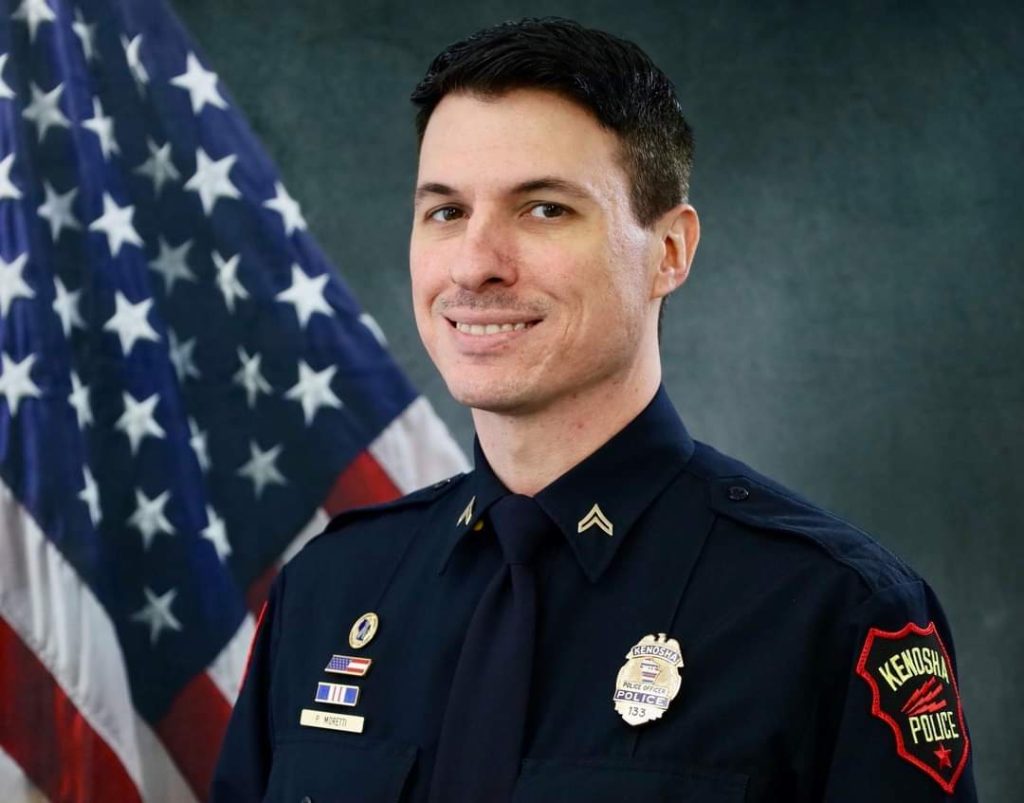
KENOSHA, Wis. — When a police officer earns his sergeant chevrons, lieutenant bars or captain bars, they usually come from the police chief, not a federal judge.
A chief calls an officer into the office and gives them the news: Congratulations. You’re being promoted.
Kenosha County Eye is not aware of a case locally where an officer has tried another route to those coveted chevrons: suing his employer and asking a federal court to conclude that the reason he didn’t get them was illegal discrimination.
But that is essentially the battle longtime Kenosha Police Officer Peter Percak, who legally changed his name to Pep Moretti in May 2011 and has also gone by “Demon Pep,” has been fighting for years.
Percak says he should have been promoted to sergeant and claims his sexual orientation is the reason he wasn’t. The City of Kenosha says that’s simply not true. The City argues Percak wasn’t denied a promotion because he is gay. Rather, the department made legitimate personnel decisions about who it wanted supervising its police officers.
That accusation also exists against the backdrop of a Kenosha Police Department whose ranks and leadership include openly gay officers, women, minorities and officers with widely differing political views.
KPD has promoted openly gay officers before Percak and has continued promoting them while his discrimination fight has been underway. One openly gay KPD officer was promoted to detective in October 2024 and then promoted again to sergeant in January 2026. The City’s attorneys specifically cite that officer’s advancement as evidence contradicting Percak’s claim that being openly gay is an impediment to promotion at KPD.
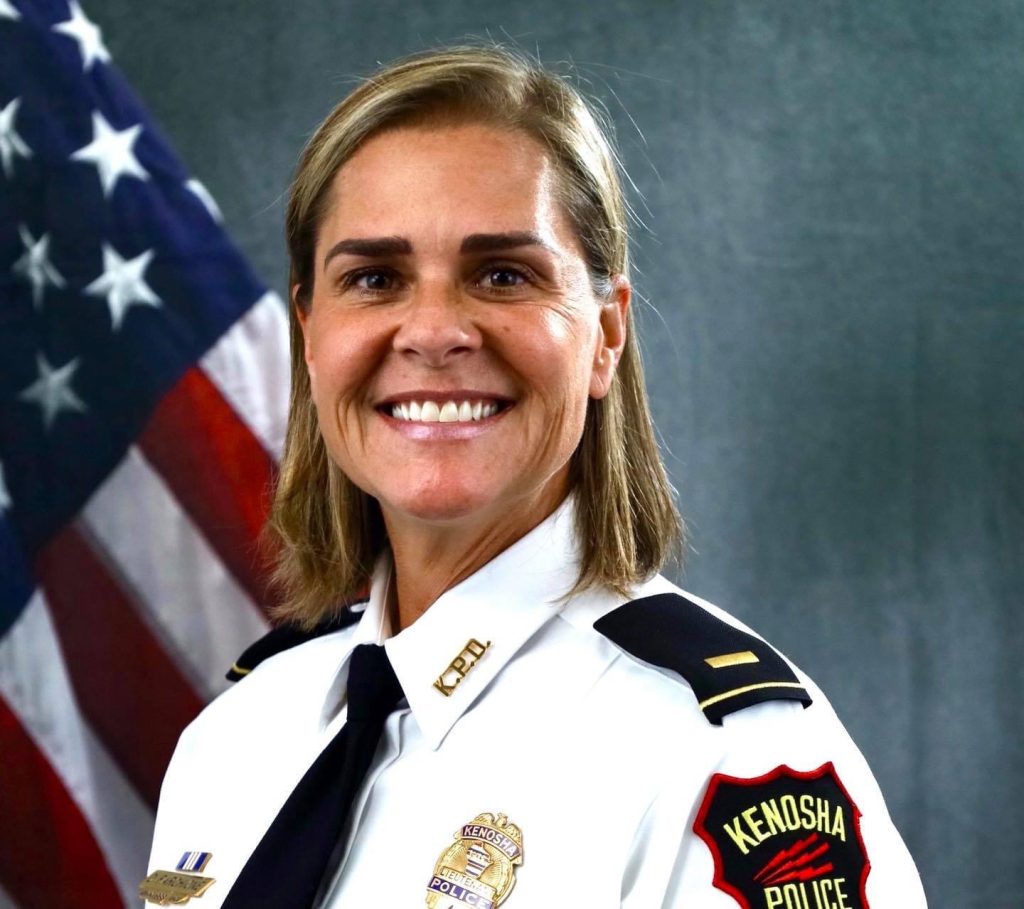
The department has also had an openly lesbian woman serve as captain and currently has an openly lesbian woman, Lieutenant Desiree Farchione, in its command structure. KPD also employs an openly gay Black officer. Sources familiar with KPD describe officers spanning the political spectrum, including very liberal and very conservative officers, although law enforcement as a profession traditionally tends to lean conservative.
Farchione is openly hostile toward KPD’s current leadership and has made no secret of her anger over not being promoted to captain. She has sharply criticized top commanders and believes she has been treated unfairly during her own efforts to advance through the department.
But unlike Percak, Farchione does not blame her sexual orientation for her failure to get promoted.
Instead, Farchione blames department leadership and disputes what KPD officials describe as multiple verbal, disciplinary-like warnings or counseling sessions from top commanders. Farchione maintains some of those conversations did not occur as described, while KPD officials maintain they have evidence documenting that they did.
Her deposition makes her unhappiness unmistakable. After being passed over for captain, Farchione complained that a male lieutenant who also didn’t make captain received consideration from Chief Patrick Patton about where he wanted to work while she did not.
“I’m not one of the guys,” Farchione testified, noting that she was the only woman among 34 members of management.
There is important context to that statistic, however. Women make up a relatively small percentage of KPD’s sworn officers in the first place. Far fewer women than men apply to become police officers, meaning the pool of female officers who could eventually accumulate the experience necessary to reach KPD’s command ranks is substantially smaller. Farchione’s status as the only woman among 34 managers therefore doesn’t, standing alone, establish that women are being systematically kept out of management.
Farchione also testified that she believes some promotions at KPD are effectively predetermined based upon “who’s liked and who’s not liked and who’s close and who’s not close.”
That makes Farchione an especially interesting witness in Percak’s lawsuit. She is not a lieutenant telling a rosy story about KPD. She is openly hostile toward its current leadership, believes management has treated her unfairly and is angry that she hasn’t been made captain. Yet even she doesn’t say being a lesbian is what kept her from getting the promotion.
Farchione testified that KPD was “very homophobic” when she began her career decades ago and said she remained closeted for years. She also described hearing occasional off-color comments involving gays and lesbians more recently. But her own career also took her from patrol officer to sergeant and ultimately lieutenant.
All of that raises an obvious question at the heart of Percak’s case: If KPD’s leadership refuses to promote officers because they are gay, why have other openly gay officers continued to rise through its ranks, including while Percak’s discrimination fight was underway?
That evidence doesn’t legally prove Percak was never discriminated against. An employer could discriminate against one gay employee while treating another fairly. But it leaves Percak needing evidence that his sexual orientation, rather than KPD’s assessment of him, was the reason he didn’t get the chevrons.
Police insiders who spoke with KCE also questioned what victory would ultimately mean for Percak. Several said that even if litigation somehow resulted in Percak becoming a sergeant, they wouldn’t personally feel they had earned their chevrons if they obtained them through a courtroom rather than being selected for promotion by their police chief.
And this isn’t Percak’s first attempt to convince a government tribunal that KPD discriminated against him.
Percak previously filed a discrimination complaint with the Wisconsin Department of Workforce Development’s Equal Rights Division. In January 2024, the state agency dismissed his complaint after finding no probable cause to believe the Kenosha Police Department discriminated against him because of his sexual orientation.
Percak then took his allegations to federal court.
According to people familiar with the litigation, the City of Kenosha has already spent potentially hundreds of thousands of dollars defending the lawsuit through extensive discovery, depositions, motions and other legal work.
Now, the City is asking U.S. District Judge William C. Griesbach to end the case without a trial. Its attorneys argue that after extensive discovery, Percak simply hasn’t produced evidence from which a reasonable jury could conclude that he was denied a promotion because he is gay.
The City’s summary judgment brief is unusually blunt. It says Percak’s claims “have no merit” and accuses his attorney of going on an “extraordinary fishing expedition desperately hoping to find some evidence” through extensive discovery. The City says the expedition came up empty.
The Promotion Percak Didn’t Get
The numbers are a central part of the City’s argument.
During the 2021 promotional process, Percak finished second on the sergeant eligibility list with a score of 100.97. Detective Benjamin Antaramian finished first with 103.24. Only one sergeant promotion was made from that list, and Antaramian, the highest-scoring candidate, received it.
After Antaramian was promoted, Percak moved into the top position. The department says it made no additional sergeant promotions because KPD was suffering from a shortage of patrol officers and did not want to further reduce the number of officers available for patrol by moving another officer into supervision.
When a new promotional process was conducted in 2023, Percak performed substantially worse. He scored 82.81 and finished near the bottom of the eligibility list. Under KPD policy, only the top five candidates could be considered for promotion, meaning Percak wasn’t eligible to be promoted from that list.
The promotional system also doesn’t guarantee that the highest-scoring eligible candidate gets the next opening. Under KPD policy, the chief can select from among the top five candidates.
In other words, making the list doesn’t mean an officer is entitled to stripes. A police chief can consider numerous legitimate factors when deciding which officers possess the judgment, leadership ability, temperament and other qualities necessary to supervise fellow police officers.
Sources familiar with KPD and the litigation told Kenosha County Eye that Percak’s sexual orientation was not the reason he failed to become a sergeant. Instead, they say Percak simply was not viewed as possessing the skills and leadership qualities decision-makers wanted in a police supervisor.
The “Demon Pep” Sexual Assault Allegations
Percak’s employment history also includes a serious sexual assault investigation.
In 2016, Percak became the subject of a sexual assault investigation after a then-20-year-old man accused a man he knew as “Demon Pep” of drugging and raping him.
The complainant told investigators that Percak came to his Twin Lakes home with alcohol. He alleged that after drinking from Percak’s cup, he quickly blacked out. The man told investigators that he briefly regained consciousness while naked and face down on his bed and believed Percak was penetrating him anally. He said he again lost consciousness and later awoke naked with pain and soreness in his rectal area.
The complainant went to a hospital and reported the alleged assault. According to investigative records previously obtained by Kenosha County Eye, he identified Percak in a photo lineup.
Percak acknowledged to investigators that sexual activity, including anal sex, occurred, but maintained that it was consensual. The central dispute therefore wasn’t whether sexual activity occurred. It was whether the complainant consented to it.
The case was handled outside Kenosha County because Percak was a Kenosha police officer. The Walworth County District Attorney’s Office ultimately did not charge him. According to records previously obtained by KCE, the complainant did not want to continue participating in the prosecution.
Sources familiar with that investigation have told KCE that investigators considered the allegations credible and that the decision not to prosecute should not be interpreted as investigators determining that the allegations were false. Percak was never criminally charged in connection with the accusation and denied sexually assaulting the man.
KPD also conducted an internal investigation. Percak was ultimately cleared of violating department policy, although he was counseled about exercising better judgment in his off-duty activities.
The prior allegations do not establish that Percak committed a sexual assault, nor do they establish why he was not promoted years later. They do, however, form part of the background of an officer now asking a federal court to conclude that unlawful discrimination, rather than management’s assessment of him as a candidate for supervision, explains why he never became a sergeant.
City Says Percak’s Retaliation Claims Don’t Add Up
Percak has also accused KPD of retaliating against him after he filed his discrimination complaint.
One allegation involved his work as a Field Training Officer, or FTO. Percak claimed the department reduced his training opportunities in retaliation.
The City’s numbers tell a very different story.
Percak had 62 FTO overtime hours in 2023, the fourth-highest total in KPD. In 2024, after filing his discrimination complaint, Percak had 104 FTO overtime hours, more than anyone else in the department. He accumulated more FTO overtime during 2023 and 2024 combined than any other KPD officer.
When his assignments were later temporarily reduced, the City says newer FTOs needed opportunities to train recruits and supervisors had concerns that Percak was experiencing “FTO burnout.” One of Percak’s final recruits in 2024 testified that Percak displayed a negative attitude toward KPD during training and that he reported those concerns to a sergeant because he feared Percak’s attitude could negatively influence future recruits.
Percak also alleged retaliation because he wasn’t selected for two specialty assignments, including a SWAT equipment operator position and an Axon body-camera instructor position.
There was a problem with that theory, too.
During essentially the same period, KPD did select Percak for two other specialized assignments: the Major Crash Assistance Team and drone equipment operator. The MCAT assignment even required KPD to pay to send Percak to specialized training at Northwestern University.
The City’s attorneys put it bluntly: they argue it “defies logic” to conclude that KPD was retaliating against Percak by denying him two specialty assignments while simultaneously selecting him for two others.
Percak even alleged that KPD retaliated against him by failing to provide backup during a potentially dangerous hospital assignment. The City says his own report tells a different story. According to the summary judgment record, the patient was handcuffed to a hospital bed, never became violent and never threatened Percak. Percak requested another officer to assist with transporting the patient, and another officer ultimately arrived and helped with the transport.
After the state rejected Percak’s discrimination complaint and years of litigation that sources say may have already cost taxpayers hundreds of thousands of dollars, the question is now whether Percak has enough evidence to put his accusations before a federal jury.
The City says he does not.
If Griesbach agrees and grants summary judgment, Percak’s unconventional attempt to prove in a courtroom that anti-gay discrimination, rather than ordinary police personnel decisions, kept him from earning his sergeant chevrons could end without ever reaching a jury.







17 Responses
How did Sgt.hard get promoted?
Different police department
Promotion is much easier with Forest Service. He could’ve been a sergeant with the “Rump Rangers”🤣
What a sad excuse of a life
Fuck tard.
Why do people have to share who they have sex with? Perverts. People use their fetishes to get hired and promoted all the time now, when it doesn’t work they whine.
Because you keep talking about it. Obsessed much?
Smartest comment I’ve seen all day.your right.this is so stupid
Lee Broadway, Kenosha fire department forced promotion. He was incapable of passing the written test.. (allegedly)
The backwards part of the KPD promotional process has always been obvious. Why would the city pay to conduct written tests and evaluations to come up with a score; Then not do promotions based off of the highest score?
Also the KPD would then not provide the candidates with copies of their evaluations (upon request), and would
‘destroy the documents”. These documents are legal “work product” on government paper, paid for with tax dollars. Nobody could argue or dispute the outcomes if the department shreds the documents.
Taxpayer funded communications or work product should all be subject to open records request, and never destroyed.
Demon Pep’s interview with the deputy is so contradictory and complete B.S. He was having sex with some boy he does not know, in a bedroom with the door off the hinges laying on the floor with the kid’s dad walking throughout the house?????? Demon repeatedly states that the kid was acting very weird and talking about drugs and his dad being in jail???? You’re a cop in your 30’s and this kid is barely legal???? All these red flags he keeps telling the deputy, and his decision was, let’s keep drinking and have sex???? Wow, what could go wrong?!?! Then he makes it sound like it was the kid’s idea?????? Not worthy of being a cop, let alone a sergeant by his decision making.
Being Gay is a protected status. The entire department should claim they’re gay. Then they’ll be untouchable. Union, Qualified Immunity, and being gay, pension. Total protection!
“Fuckin Queers!”………..paulie walnuts
I think he should have been promoted a long time ago. I’m sure KPD needs a sergeant to supervise all cavity searches 🤣
Back in the day the promotions were based on a combination of test scores, supervisor input and other factors. The Chief was given a top 5 for him to decide, based on his reasons. Guys that worked shifts with minimal supervisor input scored lower in that category. Not everyone wants to be a supervisor-you shifts move around, departments change and you are required to work more time as you are a boss. The rank and file didn’t care if you were gay/lesbian but only if you could do the job.
Curb any confidence that a proper ruling by judge Griesbach will be read. If one comes, good. 7th Circuit Federal judge Wm. Griesbach is the same judge that vacated Mark Jensen’s felony murder conviction and ruled he was to be provided a retrial, despite prima facie evidence independent of “the letter” allowed in the original conviction. Thankfully, a repeat guilty verdict was read after the irrelevant letter was procedurally deleted, finally ending an asinine 20+ year drama with a repeated maximum life without parole sentence. A total waste of taxpayer money. Justice severely delayed for meaningless procedural rigamarole is justice that is not only effectively denied, but also, arrogantly mocked.