



(File Photo by Kevin Mathewson, Kenosha County Eye)
MADISON, Wis. — Starting tomorrow, November 1, 2026, Wisconsin residents seeking justice in their own courtrooms will face significantly higher filing fees, thanks to legislation approved by Republican and Democratic lawmakers and signed into law by Democratic Governor Tony Evers. Four of the five state legislators representing Kenosha County voted for the increases, with Republican State Senator Steve Nass casting the lone local vote against the bill.

Whether you’re getting divorced, suing a landlord, trying to recover money someone owes you, or taking the government to court, the price of accessing Wisconsin’s justice system is going up. For many residents, these increases will add another financial burden to an already expensive legal process.

Are you filing for divorce? Today, it costs $184.50 to initiate a divorce without a request for support or maintenance. Tomorrow, that same filing will cost $273, an increase of nearly 48%. If you’re requesting support or maintenance, the cost jumps from $194.50 to $293.
Want to sue the government because officials illegally withheld public records? A civil action seeking no money judgment, such as a mandamus action, currently carries a filing fee of $164.50. Tomorrow, that fee jumps to $235, an increase of nearly 43%. In other words, when the government refuses to comply with the law, citizens who want a judge to intervene will have to pay even more just to get through the courthouse door.

Maybe someone owes you $5,000 and refuses to pay. Perhaps your landlord unlawfully withheld your security deposit, or you’re a landlord trying to evict a tenant who hasn’t paid rent. Filing a standard small claims action currently costs $94.50. Tomorrow, that increases to $124, a jump of more than 31%.

What if you’re suing someone for breach of contract and the amount exceeds $10,000? Today, the filing fee is $265.50. Tomorrow, it will be $356, an increase of $90.50, or more than 34%. And that’s just to file the lawsuit, not to hire an attorney, serve the defendant, conduct discovery, or actually get your day in court.

These increases aren’t isolated. A petition for a harassment injunction that doesn’t qualify for a statutory fee exemption increases from $164.50 to $235. The fee to request a jury trial in small claims court jumps from $89 to $193, more than doubling.

And don’t forget about electronic filing. Attorneys who appear in cases generally pay a $35 electronic filing fee, an expense that can be passed along to clients. That fee was previously $20 before increasing earlier this year, although it is not part of tomorrow’s new increases.

The legislation responsible for these increases, 2025 Wisconsin Act 179, originated as Assembly Bill 320. The Assembly approved it on January 22, 2026, by a vote of 65-32, with support from Republicans and some Democrats, while most Assembly Democrats opposed it.
The Senate approved the legislation, as amended, on February 11 by a vote of 31-2. Democratic Governor Tony Evers signed it into law on April 3.
All three Wisconsin Assembly representatives serving Kenosha County voted to increase the fees. Republican Amanda Nedweski (R) and Democrats Tip McGuire (D) and Ben DeSmidt (D) each voted yes.
In the Wisconsin Senate, longtime Kenosha-area Senator Robert Wirch (D) also voted yes. That means four of Kenosha County’s five state legislators supported the measure.
The lone exception was Senator Steve Nass (R), who voted against the increases. Nass was one of just two senators statewide to oppose the legislation.
The local delegation’s voting record is worth emphasizing because these increases weren’t imposed by some distant group of lawmakers with no connection to Kenosha County. Four of the five legislators representing local residents voted for them.
There are legitimate costs associated with operating a judicial system. Courthouses need employees, technology, security, judges, and clerks. Supporters of Act 179 argued that additional funding was needed to help counties operate their courts, and the legislation also provides for future inflation adjustments.
But there is also a legitimate question about how much of that burden should be placed directly on people who have no choice but to seek relief through the courts.
Getting divorced isn’t always optional. Neither is defending your property, protecting your rights, or suing someone who has wronged you. For many people, the courthouse is the only place where a dispute can be resolved with the force of law.
And starting tomorrow, getting through that door becomes substantially more expensive.
The $1.25-Per-Page Court Records Racket
The increased filing fees are only part of the problem. Another longstanding expense is the $1.25 per page that Wisconsin circuit court clerks charge for copies of court records, even when those records are already stored electronically.
In Kenosha County, Clerk of Courts Rebecca Matoska-Mentink (D) charges the full $1.25 per page even when records are requested and delivered by email. Whether the request involves one page or 1,000 pages, the per-page charge remains the same, despite the fact that electronically transmitting a larger PDF generally requires little additional effort once the document has been prepared.
On Friday, Kenosha County Eye sought a 225-page court record from the Kenosha County Clerk of Courts. At $1.25 per page, obtaining the complete document would have cost a staggering $281.25, even if delivered electronically by email. Rather than pay that amount, Kenosha County Eye reviewed the record at the courthouse and purchased only selected pages.
Now consider what the Wisconsin Department of Justice determined it actually costs to reproduce a page of paper.
In 2018, the DOJ’s Office of Open Government examined its copying costs, including paper and its copier service agreement. The agency calculated that a black-and-white copy cost just 1.35 cents per page, while a color copy cost 6.32 cents.
That means the DOJ’s documented cost of producing 225 black-and-white copies was approximately $3.04. Wisconsin’s statutory court-copying charge for those same 225 pages is $281.25, approximately 93 times the DOJ’s historical reproduction cost. That’s a difference of more than $278 for a single court document.
And that’s for physical paper. When a document is already electronic and is delivered by email, there may be no paper, toner, or physical copying expense at all.
The DOJ’s 2018 fee schedule waived charges for ordinary digital-to-digital copying, including emailing electronic records. Yet Wisconsin’s circuit court fee statute specifically authorizes the $1.25-per-page charge, illustrating how differently the government treats ordinary public records requests and requests for court records.
The DOJ also warned in its 2018 advisory that public records authorities generally cannot profit from records requests, except where different charges are specifically authorized by law. That statutory exception is precisely what makes Wisconsin’s court-copying fee so frustrating.
Years ago, Senator Steve Nass told Kenosha County Eye that the state’s $1.25-per-page court-copying charge was essentially a giant slush fund for the state. Nass said at the time that he was looking into changing the fee, but Kenosha County Eye is unaware of any subsequent change resulting from those discussions.
The characterization was striking coming from a sitting state senator. It also raises an obvious question: If lawmakers have known about concerns surrounding these charges for years, why does the public still pay $1.25 per page, including for records that can be delivered electronically?
Nass voted against the new court-fee increases taking effect tomorrow. But the longstanding copying charge remains in place, and the problem he previously discussed with Kenosha County Eye has not been resolved.
The actual net revenue from these copying charges depends on staffing, equipment, administrative expenses, and how the money is distributed. The DOJ’s historical reproduction costs are not a complete accounting of the cost of operating a clerk’s office, but they demonstrate how dramatically the statutory copying charge can exceed the basic expense of reproducing a document.
Public court records belong to the public. The courts aren’t private businesses, and access to judicial records shouldn’t become a luxury reserved for people willing to pay hundreds of dollars for ordinary documents.
Kenosha Clerk Of Courts Candidates Address Fees
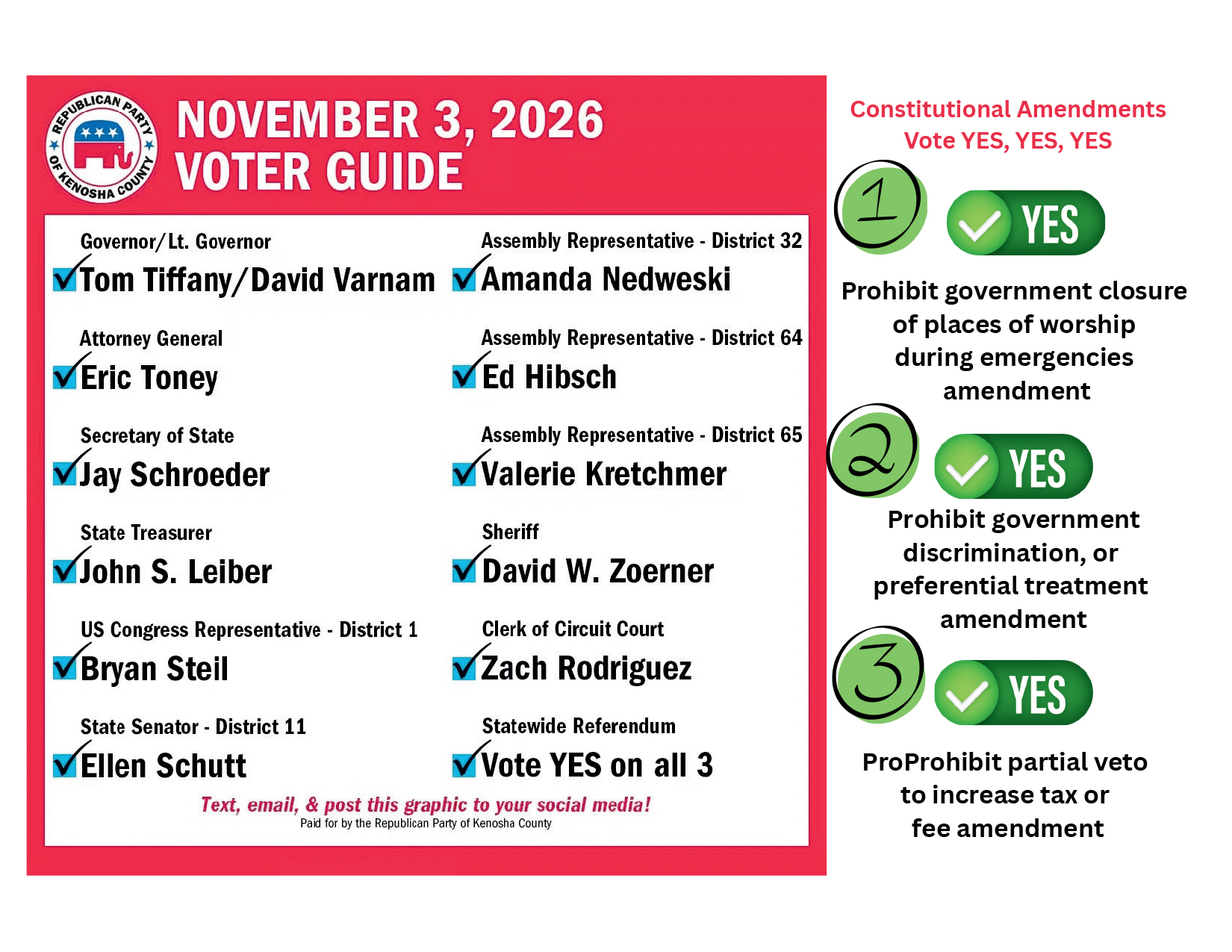
With longtime Clerk of Courts Rebecca Matoska-Mentink (D) retiring at the end of the year, Kenosha County voters will choose her replacement in Tuesday’s November 3 election. The two candidates are current courthouse employee Brian Sheffler (D) and former three-term Kenosha County Board Supervisor Zach Rodriguez (R).
During his tenure on the Kenosha County Board, Rodriguez introduced legislation to reduce the county’s public records copying fee from 25 cents per black-and-white page to just 10 cents, a 60% reduction. For comparison, a 225-page document from Kenosha County would have previously cost $56.25 under the old fee schedule, compared with just $22.50 under the reduced fee, saving taxpayers $33.75 on a single request.
To the county’s credit, Kenosha County has recently been providing electronic copies of public records without charging copying fees. That means the same 225-page document could cost nothing if provided electronically, rather than the $281.25 charged for an equivalent number of pages by the Clerk of Courts.
Sheffler does not intend to change the existing court-copying fees, according to information provided to Kenosha County Eye. Rodriguez, however, told Kenosha County Eye on Saturday that he is aware of the rising costs of accessing Wisconsin’s court system and would examine what could be done locally.
Rodriguez said that if elected, he would evaluate fees within the Clerk of Courts’ authority to determine whether changes could help residents obtain court records and access court services more affordably. He did not promise to eliminate or reduce the $1.25-per-page charge, which is established by state statute rather than simply by the discretion of an individual county clerk.
That distinction is important. Many of the filing and copying fees are established by the Wisconsin Legislature, meaning a county clerk cannot simply disregard them. But clerks do oversee administrative practices, records management, and aspects of courthouse operations that can affect how easily and affordably the public obtains information.
The question is what options exist within the law to make court records more accessible and whether state lawmakers will reconsider the statutory charges themselves.
For Wisconsin residents already facing higher filing fees, attorney expenses, and the cost of pursuing justice, even modest changes to local practices could make a difference.
And when the public is being charged $1.25 per page for documents delivered by email, asking whether the system could operate more efficiently is hardly unreasonable.
Justice Shouldn’t Be A Luxury
The Legislature has the authority to establish court fees, and lawmakers can argue that increased revenue is needed to support court operations. But that doesn’t make the consequences any less real for the Wisconsin residents required to pay them.
When an ordinary resident needs to sue a government agency, recover unpaid wages, resolve a contract dispute, or end a marriage, that resident often has to pay out of pocket. Those expenses come on top of taxes already paid to support the courts.
Wisconsin law does provide fee waivers for qualifying individuals, and some proceedings remain free. But that doesn’t eliminate the burden on working families who don’t qualify for a waiver and still struggle to afford legal representation.
The state is asking people to pay more at precisely the moment they need the justice system to resolve something important in their lives.
This isn’t simply a Republican issue or a Democratic issue. The legislative record shows bipartisan support for the fee increases, as well as substantial Democratic opposition in the Assembly and opposition from Republican Senator Steve Nass. Four of Kenosha County’s five legislators voted yes, and Governor Tony Evers signed the legislation.
Wisconsin residents already pay taxes to operate their government. They pay for courthouses, judges, prosecutors, clerks, and the judicial system itself. When they need that system to protect their rights, they encounter another bill.
Starting tomorrow, that bill gets bigger.
And for people who are already struggling to afford justice, the difference between $94.50 and $124, or $265.50 and $356, isn’t just another line in a government fee schedule.
It’s money they may not have.
The question Wisconsin lawmakers should have to answer is simple: At what point does the cost of accessing justice become a barrier to justice itself?
Correct the election timing and datelineClarify the fee-change effective date