



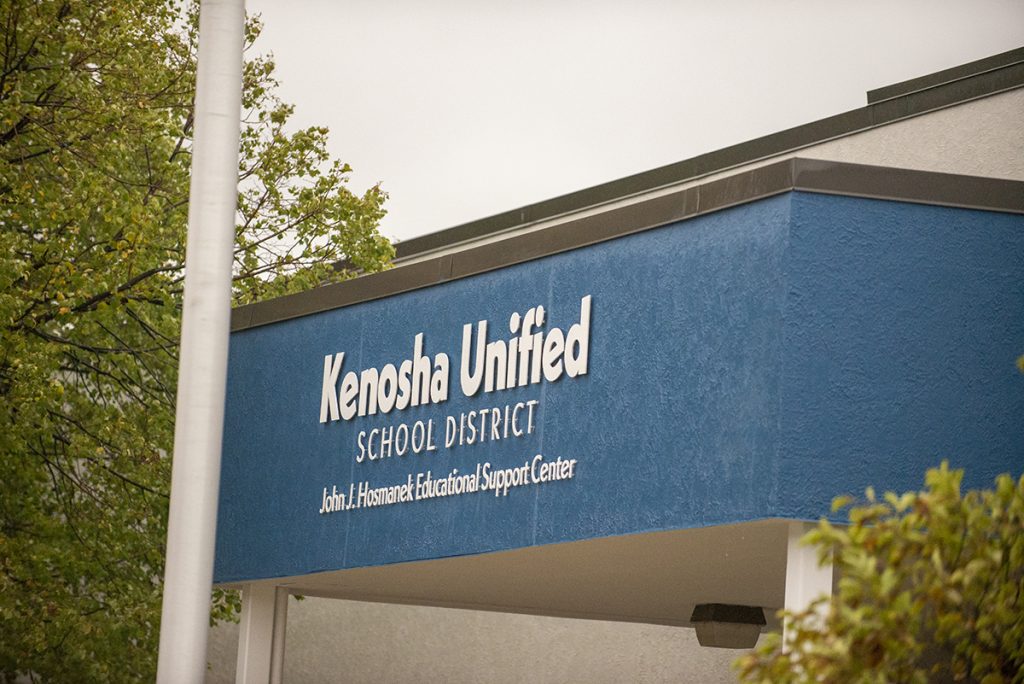
(File Photo by Kevin Mathewson, Kenosha County Eye)
KENOSHA, Wis. — The Kenosha Unified School District (KUSD) received another disappointing assessment from the Wisconsin Department of Public Instruction (DPI) Tuesday, November 17, 2026, with newly released state report cards showing the district performing near the bottom of Wisconsin in several critical measures of academic achievement and student success. Although the district maintained its three-star “Meets Expectations” designation, its overall score declined from 63.7 last year to 62.6 this year, and a closer examination of the state’s 11-page report reveals troubling academic deficiencies affecting thousands of Kenosha students.

The district, which serves approximately 17,635 students, scored as well as or better than just 10.6% of Wisconsin school districts in academic achievement, placing it among the lowest-performing districts in the state in that category. Even more concerning, KUSD scored as well as or better than just 4.5% of districts in the state’s “On-Track to Graduation” category, a measure that examines whether students are making adequate progress toward completing their education.

The report also shows that KUSD scored as well as or better than only 13.1% of Wisconsin districts in outcomes for students with the lowest test scores. These statewide comparisons paint a considerably less favorable picture than the district’s overall three-star designation might suggest.

According to the DPI report, KUSD earned an achievement score of 55.8 out of 100, compared with the statewide K-12 score of 64.1 in English language arts and 65.6 in mathematics. Kenosha’s subject-specific scores were 56.9 in English language arts and just 54.6 in mathematics, placing the district substantially behind statewide performance in both subjects.

Perhaps one of the most alarming findings involves the percentage of Kenosha students actually meeting state academic standards. According to the report, only 43.2% of tested KUSD students performed at the Meeting or Advanced levels in English language arts during the 2025-26 school year, while just 40.4% reached those levels in mathematics.

That means approximately 57% of tested Kenosha students were performing below the Meeting level in English language arts, while nearly 60% were below that level in mathematics. These figures represent thousands of students who have not demonstrated grade-level proficiency under the state’s testing standards.

The mathematics results are particularly troubling because they show a deterioration in the lowest performance category. During the 2023-24 school year, 28% of tested KUSD students were classified as Developing in mathematics, the state’s lowest performance category. That percentage increased to 30.1% in 2025-26, meaning nearly one in three tested students now falls into that category.

Reading proficiency among younger students also raises serious questions about the district’s effectiveness in teaching foundational academic skills. According to DPI, only 42.2% of KUSD third graders were reading at grade level, compared with 50.6% statewide. That means nearly six out of every ten Kenosha third graders were not reading at grade level under the state’s assessment measure.
Third-grade reading performance is particularly important because students transition from learning to read toward using reading skills to learn other subjects. Students who struggle with reading at that stage can face additional challenges in mathematics, science, history and other academic areas as they progress through school.
The district’s eighth-grade mathematics performance provides another troubling indicator. KUSD received a score of 55.8 in that category, compared with the statewide score of 69.5, a difference of 13.7 points. The scores are points-based proficiency measures rather than percentages of students passing, but the substantial gap illustrates how far Kenosha trails the statewide benchmark.
Chronic absenteeism remains another significant problem. The latest available single-year figures show that 27.6% of KUSD students were chronically absent during the 2024-25 school year, compared with 17.5% statewide. Students are considered chronically absent when they miss more than 10% of school days.
Kenosha’s chronic absenteeism rate actually increased from 25.9% in 2023-24 to 27.6% in 2024-25, reversing some of the improvement recorded after the 2022-23 school year, when the rate was 29.5%. The latest figures mean more than one in four KUSD students were missing a substantial amount of instructional time.
The absenteeism problem is especially pronounced among certain student populations. According to the DPI report, 40.9% of Black students, 38.1% of economically disadvantaged students and 37.9% of students with disabilities were chronically absent during the 2024-25 school year. Those rates are substantially higher than the districtwide average and raise additional concerns about the challenges facing some of Kenosha’s most vulnerable students.
Significant achievement gaps also remain between student populations. Among Black students tested in English language arts, only 19.4% reached the Meeting or Advanced performance levels, compared with 57.7% of white students. In mathematics, just 15.7% of Black students met those standards, compared with 55.8% of white students.
Students with disabilities experienced some of the district’s lowest academic outcomes. Just 11% reached the Meeting or Advanced levels in English language arts, while 11.3% achieved those levels in mathematics. The report also shows that 60.9% of students with disabilities were classified as Developing in English language arts and 65.2% received that classification in mathematics.
The district’s results were not uniformly negative. KUSD’s four-year graduation rate was 91.5%, slightly below the statewide rate of 91.8%, and its seven-year graduation rate was 92.7%, compared with 93.4% statewide. The district also exceeded statewide participation rates in dual-enrollment coursework, with 38.3% of high school students successfully completing at least one dual-enrollment course, compared with 25.7% statewide.
However, the report raises an important distinction between students graduating and students demonstrating academic proficiency. While more than nine out of ten KUSD students in the reported four-year graduation cohort earned diplomas, substantially fewer students in the district’s tested grades demonstrated proficiency in reading and mathematics. These figures measure different student groups and should not be interpreted as showing that the same graduating students failed proficiency tests.
Individual school ratings also varied considerably. Of the district’s 30 schools included in the accountability summary, one received the state’s lowest rating of “Fails to Meet Expectations,” while six others received “Meets Few Expectations.” Together, those seven schools accounted for 23.3% of the schools included in the district’s report.
Thirteen schools received “Meets Expectations,” seven received “Exceeds Expectations,” and two received the highest rating of “Significantly Exceeds Expectations.” One additional school participated in an alternate accountability process and received a designation of “Satisfactory Progress.”
The highest-performing schools included Jeffery Elementary School and LakeView Technology Academy, which received the state’s highest rating. Bose, Frank, Nash, Prairie Lane, Roosevelt, Somers and Whittier received “Exceeds Expectations” ratings.
The wide variation in school performance illustrates that some KUSD schools are producing substantially stronger results than others. Individual school accountability scores ranged from a low of 48.1 to a high of 86.7, a difference of 38.6 points.
In a news release Tuesday, KUSD emphasized that it had maintained its overall “Meets Expectations” rating and highlighted improvements at several schools. The district pointed to 10 schools whose scores increased by an average of at least 4.7 points, including Forest Park Elementary School, which experienced a 16.6-point increase.
KUSD Superintendent Dr. Jeff Weiss characterized the report cards as one measure of student performance and emphasized that they do not capture every aspect of the district’s educational work. Weiss also said the district was encouraged by progress at individual schools while acknowledging that additional improvements were necessary.
The district’s announcement did acknowledge the 1.1-point decline in its overall score, but its emphasis was largely on maintaining the three-star designation and celebrating individual school improvements. The underlying DPI report provides a more complicated picture, particularly when comparing Kenosha’s academic achievement, attendance and student outcomes with those of other Wisconsin districts.
State accountability scores are calculated using a combination of academic achievement, student growth, outcomes for the lowest-performing students and measures associated with graduation readiness. The overall score is not equivalent to a traditional classroom grade, and the state’s rating system allows districts to receive a “Meets Expectations” designation despite performing poorly relative to other districts in individual categories.
For KUSD, that distinction is significant. A district can receive three stars while scoring in the bottom portion of Wisconsin districts for academic achievement, outcomes among struggling students and indicators of graduation readiness.
The district’s report also shows that its student growth score of 60.3 was as high as or higher than 37.3% of Wisconsin districts. Although that result is stronger than Kenosha’s relative standing in academic achievement, it still places the district below most Wisconsin school districts in the growth measure.
The latest report cards leave Kenosha taxpayers and parents with important questions about whether district leadership is doing enough to address longstanding academic deficiencies. While individual schools have demonstrated that stronger outcomes are possible, the districtwide figures show that a substantial proportion of Kenosha students continue to struggle with basic academic skills.
For the thousands of families who depend on KUSD to educate their children, the most important measure of success may not be whether the district maintains its three-star designation. It may be whether more students can read at grade level, demonstrate proficiency in mathematics, attend school consistently and graduate prepared for the demands of adulthood.
The Wisconsin Department of Public Instruction’s latest report suggests that Kenosha Unified still has considerable work to do in each of those areas.
























3 Responses
We aren’t teaching your kids or holding them or ourselves accountable, but please give us $17 million dollars to blow!
No surprises here. All that’s left to say is, “told ya”.
Let’s be honest. All of the school that exceed expectations are basically in the higher end neighborhoods…. This is not surprising.
Weiss needs to go. Year over year he has done nothing to improve KUSD.