



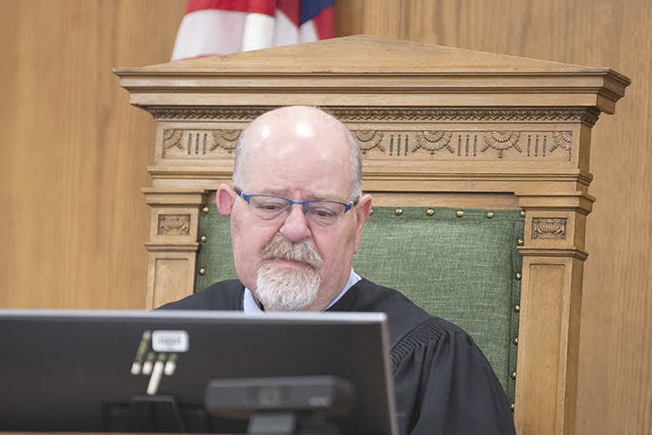
(File Photo by Kevin Mathewson, Kenosha County Eye)
KENOSHA, Wis. — Kenosha County Circuit Court Judge David Wilk recently issued a bizarre ruling that weakens a restraining order Wilk personally granted and creates a dangerous social-media loophole for future violators.
The case involved a person protected by a restraining order who was repeatedly contacted on the protected person’s own social-media account by the person subject to that order. Ownership and control of the account were never disputed. The communications tagged the protected person’s account and used insulting language directed unmistakably at the protected person. The protected person was called a “fucking idiot,” “pussy ass bitch,” “retarded,” and “bunk ass.” All clear violations.
This was actual contact. The respondent deliberately entered the protected person’s social-media account and posted communications directed at the protected person. Wilk nevertheless denied contempt because the contact occurred through social media rather than through a personal telephone number or email address.
That distinction defies common sense. A person cannot avoid a restraining order by routing harassment through social media. When a communication is posted directly on the protected person’s account, tags that account and addresses the protected person, it is contact.
Attorney Allowed To Supply Client’s Testimony
The respondent did not testify, take an oath, face questioning or personally explain the intent behind the communications. Instead, the respondent’s attorney supplied an explanation about what the client supposedly knew, believed and intended.
When an objection was raised, Wilk acknowledged that the attorney was not under oath and said the statements were not evidence. Wilk then relied upon that same explanation when ruling that the respondent had not intentionally violated the order.
Calling disputed factual assertions “argument” does not change what happened. The attorney supplied the client’s version of events without an oath or cross-examination, and Wilk relied upon it.
Wilk also refused to allow the respondent to be called as an adverse witness because contempt could potentially result in incarceration. That prevented meaningful questioning about the intended recipient and the decision to continue making contact.
This was a civil proceeding. Wisconsin law allows a witness to invoke the Fifth Amendment, but an invocation can support an adverse inference in a civil case. Wilk allowed no questioning, drew no adverse inference and then accepted the explanation supplied by the respondent’s attorney.
A Contempt Finding Disguised As A Warning
Even while denying contempt, Wilk warned the respondent that another social-media contact could result in contempt.
That contradicted Wilk’s own ruling.
Wisconsin law allowed Wilk to find the respondent in contempt while declining to impose an immediate sanction. Wilk could have said, “The respondent violated the order, but no sanction will be imposed at this time. Another violation will result in sanctions.”
Instead, Wilk used dimwitted logic to deny contempt entirely and then warned that repeating the same conduct would be contemptuous.
If the conduct did not violate the injunction, there was no reason for the warning. If repeating the conduct would constitute contempt, the conduct already before the court should have resulted in a contempt finding.
Wilk transformed what should have been a contempt finding into a warning without labeling it as one. In practical terms, Wilk gave the respondent a free violation.
The Plaza Case Makes Wilk’s Hypocrisy Worse
The ruling is even more disturbing because Wilk belongs to the same Kenosha County judiciary that recently removed and ultimately fired former Court Commissioner William “Bargain Bail Billy” Michel II following the Makayla Rutka-Plaza restraining-order catastrophe.
In February 2026, 28-year-old Makayla Rutka-Plaza sought a harassment injunction against estranged husband Marckus Plaza. Makayla asked for only four months of protection during a toxic divorce and pleaded with the court to keep Marckus Plaza away from the home.
Michel denied the request. Less than two months later, Marckus Plaza was charged with first-degree intentional homicide in Makayla’s death.
After the killing, Kenosha County judges removed Michel from restraining-order cases. Sources familiar with the decision told Kenosha County Eye that judges had lost confidence in Michel’s judgment following Makayla’s death. Michel was later fired amid scrutiny of the Plaza decision, bail rulings, courtroom conduct and other restraining-order cases.
Wilk is part of that same judiciary.
Out of one side of the judiciary’s mouth, the public is told that restraining orders must be treated so seriously that a court commissioner who mishandled one was stripped of those cases and ultimately fired.
Out of the other side, Wilk says a restraining order Wilk personally granted can be violated through social media, at least until Wilk decides that the next violation will finally count.
The contradiction is staggering.
Restraining orders are not academic exercises. The Plaza case demonstrated the potentially fatal consequences of judicial underreaction. Wilk should understand that better than almost anyone. Instead, Wilk weakened the force of an existing order, excused proven contact and converted contempt into an unofficial warning.
A Dangerous Loophole
Wilk’s ruling does not create binding statewide precedent, but the reasoning provides a blueprint for circumventing protective orders.
Under Wilk’s logic, a restrained person could contact a protected person through a business account, public profile, employer account or other social-media account and then claim the communication was directed at the account rather than the human being operating it.
Restraining orders commonly prohibit contact in person, by telephone, in writing, electronically or in any other manner. Judges do not normally prohibit one form of contact while leaving every other form available.
Wilk nevertheless created what amounts to a social-media exception.
A Larger Problem With Wilk
Many judges are criticized for difficult judgment calls. Wilk is criticized for something more fundamental: incompetence and an extraordinarily slow calendar.
Lawyers who regularly practice in Kenosha County commonly describe Wilk’s calendar as the slowest in the courthouse. Motions can sit for months before being heard. Hearings become unnecessarily long because Wilk is notoriously long-winded. Litigants wait, legal bills increase and disputes remain unresolved.
Wilk also brings unnecessary pomp into the courtroom, requiring ceremonial silence and an announcement that “The Honorable David P. Wilk” is presiding while using bailiffs to fetch coffee like personal errand runners.
Wilk attended Hamline University School of Law in Minnesota, which one local attorney described to Kenosha County Eye as “one of the worst law schools in the United States.” A law-school pedigree does not automatically determine judicial competence, but Wilk’s courtroom performance has done little to overcome that assessment.
Wilk is not necessarily malicious. The more likely explanation is simple incompetence. Wilk is slow, painfully long-winded, startlingly gullible and seemingly unable to apply ordinary common sense to straightforward legal disputes.
Wilk personally granted this restraining order. Wilk then excused repeated social-media contact that violated it. Wilk finally warned that another similar contact could result in contempt.
That is not coherent judging. It is an arbitrary declaration that a restraining order can be violated until Wilk decides otherwise.
An appellate court should correct this dangerous mistake.















2 Responses
Like father like son.
Wilk is another example of the incestuous power structure in Kenosha government. Because his father was a judge, he gets the same job.
This repeats itself over and over.