



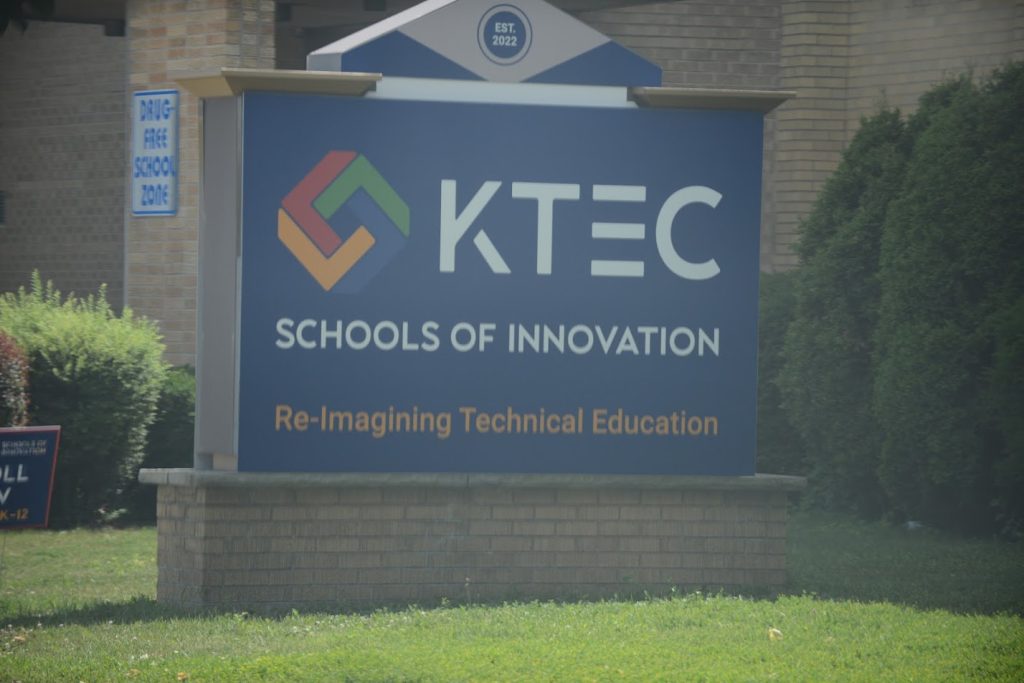
(Photo of School by Kevin Mathewson, Kenosha County Eye)
KENOSHA, Wis. — The financially troubled KTEC Schools of Innovation, founded and led by Angela Andersson (D), has received another dismal report card from the Wisconsin Department of Public Instruction (DPI), marking the third consecutive year the independent public charter school has earned the state’s two-star rating of “Meets Few Expectations.” Even worse, the school’s overall accountability scores have declined each year, falling from 51.9 in 2023–24 to 50.7 in 2024–25 and 50.4 in 2025–26. The latest report places KTEC’s academic growth score at or above just 5.7% of Wisconsin K–12 schools, putting it near the bottom 6% statewide for student academic growth. The results come as KTEC faces questions about its finances, including a previously reported $379,195 annual deficit, and new allegations received by Kenosha County Eye concerning school security, employee turnover, inadequate special education staffing, and violence against teachers. Andersson, who serves as the school’s “CEO,” has not provided KCE with answers to its previous questions about the school’s management, and KCE is seeking her response to the latest academic results and allegations.


(File Photo by Kevin Mathewson, Kenosha County Eye)
The school should not be confused with the original KTEC elementary and middle school, which opened in 2007 and operated under the Kenosha Unified School District (KUSD) for nearly two decades. Andersson, who previously served as principal of the original KTEC, helped establish a separate KTEC High School in 2022 under a charter authorized by the University of Wisconsin’s Office of Educational Opportunity. Following a contentious separation between KUSD and the original KTEC governance board in January 2025, the independent organization expanded to serve younger students and eventually became a 4K–12 school system. KUSD retained the original elementary and middle school program under the name LakeView K-8 Academy, while Andersson’s independent organization continued using the KTEC name.

The newest report card is particularly troubling because it reflects the expanded school operation rather than just the original independent high school. The 2025–26 report identifies KTEC Schools of Innovation as serving grades 4K through 12, with an enrollment of 317 students. The previous report cards evaluated the smaller KTEC High School, meaning the year-to-year scores are not perfectly comparable because the student population and grade levels changed.

Three Consecutive Years Of Poor Report Cards
KTEC’s overall accountability score has declined in each of the last three rated school years. The school received 51.9 points in 2023–24, followed by 50.7 points in 2024–25 and 50.4 points in 2025–26. Each score resulted in the same two-star designation of “Meets Few Expectations,” the second-lowest rating available under Wisconsin’s school accountability system.

The downward trend is especially concerning because the school has repeatedly promoted its innovative educational model, technology-focused curriculum, industry certifications, and individualized learning opportunities. Despite those promises, its official state accountability ratings have remained near the bottom of the rating scale for three consecutive years.

The school’s 2022–23 report card received an alternate rating of “Satisfactory Progress” because insufficient information was available to calculate a standard overall accountability score. Therefore, the three consecutive two-star ratings began with the 2023–24 school year, not 2022–23.

Academic Growth Among The Worst In Wisconsin
Perhaps the most alarming finding in the newest report card involves student academic growth. DPI awarded KTEC a growth priority area score of just 47.0 out of 100, compared with a statewide K–12 score of 66.0. The school performed as well as or better than only 5.7% of K–12 schools statewide on that measure.

That means approximately 94% of Wisconsin K–12 schools scored higher than KTEC on academic growth. The growth measure evaluates how much academic progress students make from year to year, taking into account factors outside educators’ control.
KTEC’s mathematics growth score was 45.1, compared with the statewide score of 66.0. Its English language arts growth score was 48.9, compared with 66.0 statewide.
DPI also uses a value-added measure to evaluate student progress relative to similarly situated students. A score of 3.0 represents average growth. KTEC received a value-added score of just 2.1 in English language arts and 1.9 in mathematics, indicating students were making less progress than expected compared with similar students elsewhere.
The mathematics value-added score was particularly troubling among economically disadvantaged students, who received a score of 1.8. Students with disabilities also received a mathematics value-added score of 1.8, while their English language arts score was 2.0.
Nearly Three Out Of Four Students Failed To Meet Mathematics Expectations
The latest report card also reveals significant problems with basic academic proficiency. During the 2025–26 school year, 159 students were tested in mathematics, and only 5.7% reached the advanced performance level. Another 20.8% met expectations, while 26.4% were classified as approaching expectations and 47.2% were classified as developing.
Combined, approximately 73.6% of tested KTEC students failed to meet or exceed grade-level mathematics expectations. Nearly half of the students tested were in the lowest performance category, developing.
English language arts results were also disappointing. Of the 159 students tested, just 5.7% reached the advanced level and 27.7% met expectations. Another 32.1% were approaching expectations, while 34.6% were developing.
That means approximately 66.7% of tested students failed to meet or exceed English language arts expectations. The results raise questions about whether the school’s educational approach is delivering adequate instruction in fundamental academic subjects.
KTEC’s overall academic achievement score was 40.7, compared with the statewide K–12 score of 64.1 in English language arts and 65.6 in mathematics. The school’s combined achievement score placed it at or above only 23.9% of K–12 schools statewide.
The mathematics achievement score was just 37.4, compared with 65.6 statewide, while English language arts achievement was 43.9, compared with 64.1 statewide.
Students With Disabilities Performing Particularly Poorly
One of the most concerning findings involves students with disabilities, especially given the recent allegations KCE received concerning special education staffing and resources.
Among the 34 students with disabilities tested in English language arts during 2025–26, just 5.9% reached the advanced level and another 5.9% met expectations. A staggering 70.6% were classified as developing, the lowest performance category, while another 17.6% were approaching expectations.
In mathematics, the results were even worse. Just 2.9% of students with disabilities reached the advanced level, while 5.9% met expectations. Another 14.7% were approaching expectations, and 76.5% were classified as developing.
Combined, approximately 91.2% of tested students with disabilities failed to meet or exceed mathematics expectations. In English language arts, approximately 88.2% failed to meet or exceed expectations.
The school’s mathematics achievement score for students with disabilities was just 15.9, while its English language arts achievement score was 21.2. Those results warrant serious questions about the adequacy of academic support available to some of the school’s most vulnerable students.
The scores do not, by themselves, establish that KTEC violated special education laws or failed to provide legally required services. However, when considered alongside the allegations concerning inadequate staffing, they provide additional reasons for examining the school’s special education program.
Half Of Students Chronically Absent
Attendance is another area where KTEC’s performance has been substantially worse than statewide averages. The newest report card lists schoolwide attendance at just 84.6%, compared with 92.6% statewide.
Even more troubling, the report shows that 50% of KTEC students were chronically absent during the 2024–25 school year, compared with 17.5% statewide. Chronic absenteeism generally means missing more than 10% of school days.
The problem has persisted for years. KTEC’s chronic absenteeism rate was 51.2% in 2022–23, 49.1% in 2023–24, and 50.0% in 2024–25.
Among economically disadvantaged students, the chronic absenteeism rate reached 59.6% in 2024–25. That means nearly six out of every ten economically disadvantaged students were chronically absent.
The school’s chronic absenteeism component score was just 50.1, compared with 81.8 statewide. The attendance figures raise additional questions about student engagement, school culture, and whether the school’s leadership has implemented effective strategies to improve attendance.
State Reports More Law Violations Than Statewide Average
The 2025–26 report card also includes information about certain criminal charges and municipal citations associated with incidents occurring on school property, during school activities, or on school-provided transportation.
According to the report, KTEC had a rate of 3.8 reported charges or citations per 100 students, compared with a statewide rate of 1.4. That is approximately 2.7 times the statewide rate.
For certain categories involving homicide, sexual assault, specified batteries, and disorderly conduct ordinance violations, the school reported a rate of 0.9 per 100 students, compared with 0.6 statewide.
DPI specifically cautions that these figures have significant limitations and should not be used to assess school safety or compare schools. The statistics count qualifying charges and citations, not necessarily proven misconduct, and do not establish that the incidents involved assaults against teachers or any of the specific allegations received by KCE.
Nevertheless, the figures are another reason to seek detailed records about incidents occurring on school property, particularly in light of the recent concerns brought to KCE’s attention.
New Allegations About School Safety And High Employee Turnover
On October 14, 2026, Kenosha County Eye received an anonymous tip from someone identifying themselves as Van Morrison, raising serious concerns about operations inside KTEC’s newly opened school building.
The tipster alleged that multiple employees had resigned since the building opened and questioned whether the departures were connected to concerns about Andersson and her administrative team. The individual also alleged that students with significant special education needs were being enrolled without adequate staffing or resources.
The message further alleged that students had verbally threatened and physically assaulted teachers, raising questions about whether administrators were taking appropriate steps to protect employees and maintain a safe learning environment.
The tipster also alleged that exterior doors were being left unlocked or unmonitored and that teachers were being prohibited from using two-way radios. According to the message, employees were instead being directed to communicate through Microsoft Teams during emergencies.
Those allegations, if substantiated, would raise significant concerns about the school’s ability to respond quickly to violence, lockdowns, medical emergencies, or other situations requiring immediate communication.
Kenosha County Eye has not independently verified the allegations and is seeking records to determine whether they are supported by documented incidents, staffing changes, complaints, or school policies.
KCE has requested information concerning employee separations, special education staffing, workplace incidents, security procedures, emergency communications, and administrative oversight. Andersson has been given an opportunity to address the concerns.
Financial Troubles Add To Questions About Leadership
The school’s academic performance is unfolding against a backdrop of financial challenges. According to previously reviewed federal nonprofit financial records, KTEC reported $1,645,540 in revenue and $2,024,735 in expenses for the fiscal year ending June 30, 2025.
That produced a $379,195 operating deficit, raising questions about the organization’s financial stability and ability to support its growing educational responsibilities.
The organization also disclosed significant borrowing associated with its expansion. KTEC obtained a $500,000 loan in December 2024, with approximately $482,668 outstanding at the end of June 2025.
Following the end of that fiscal year, the school closed on approximately $17.9 million in bonds to finance its new facility. The borrowing created substantial long-term financial obligations for an organization that had recently reported expenses exceeding revenue.
Those financial commitments are especially significant because the school has expanded from a small independent high school into a much larger operation serving students from four-year-old kindergarten through twelfth grade.
The expansion has required additional teachers, support staff, administrators, facilities, and educational resources. Whether the school’s revenues and financial planning are sufficient to support those responsibilities remains an important question for its leadership and governing board.
KUSD Previously Raised Concerns About Financial Management
KTEC’s separation from the Kenosha Unified School District was contentious. In January 2025, the KUSD School Board approved terminating its charter relationship with the original KTEC organization after district officials raised concerns about financial management and the handling of funds involving the original district-affiliated school and the independently operated high school.
The original KTEC governance board disputed the district’s allegations and criticized KUSD’s decisions. The disagreement ultimately resulted in the separation of the two educational operations.
KUSD retained the original elementary and middle school program under the name LakeView K-8 Academy. Andersson’s independent KTEC organization continued operating separately and subsequently expanded to serve younger students.
The distinction is important because families familiar with the original KTEC may not realize that the current independent KTEC Schools of Innovation operates under a different governance and oversight arrangement.
The academic results described in this story concern Andersson’s independent organization, not KUSD’s LakeView K-8 Academy.
Questions About Andersson’s Husband Serving On Governance Board
Kenosha County Eye has also previously questioned the school’s governance structure, particularly the arrangement under which Andersson served as the school’s “CEO” while her husband, Arthur Andersson, served on its Governance Board.
KCE sought information about whether the arrangement had been reviewed for potential conflicts of interest and whether Arthur Andersson had participated in decisions affecting his wife’s employment, compensation, or administrative authority.
CESA 6 officials acknowledged KCE’s correspondence and provided certain employee compensation information, but the responses available to KCE did not substantively resolve the conflict-of-interest questions.
Arthur Andersson is no longer listed among the school’s current voting board members. The circumstances surrounding his departure have not been established, and KCE has sought additional records concerning any resignation, ethics review, or conflict-of-interest determination.
His former board membership does not, by itself, establish that any law or policy was violated. However, the arrangement raises legitimate questions about the independence of board oversight at a publicly funded school.
KTEC Promotes College Credits And Industry Certifications
Despite its poor academic accountability ratings, KTEC has highlighted other aspects of its educational model, particularly dual enrollment opportunities and industry-recognized credentials.
The latest DPI report card shows that, during the 2024–25 school year, 91.7% of eligible high school students successfully completed at least one dual enrollment course, compared with 25.7% statewide. The report also shows that 61.1% earned at least one industry-recognized credential, compared with 6.8% statewide.
Those results represent areas where KTEC substantially exceeded statewide participation rates and are relevant to its career-focused educational mission.
However, the same report shows that no students successfully completed an Advanced Placement or International Baccalaureate course during the reporting period, compared with 22.9% statewide. Just 2.8% participated in work-based learning programs, compared with 8.0% statewide.
The report also indicates that no students successfully completed courses in art and design, dance, music, or theater during the 2024–25 reporting period.
The school has emphasized alternative educational opportunities and industry preparation, but those offerings do not eliminate the importance of students demonstrating proficiency in reading, writing, and mathematics.
Will Andersson Answer Questions About The Results?
Kenosha County Eye has repeatedly sought information concerning the management and oversight of KTEC. The newest report card raises additional questions about why the school’s overall accountability scores continue to decline and what specific actions Andersson and the governing board are taking to improve student achievement.
KCE is also seeking answers about the school’s financial position, employee turnover, special education resources, and the safety allegations received in October.
The public records request remains outstanding, and KCE is evaluating its options for obtaining the requested records under Wisconsin’s public records law. Wisconsin Statute § 19.35(4)(a) requires public authorities to respond to records requests as soon as practicable and without delay.
Andersson has been offered an opportunity to explain the school’s academic performance and respond to the allegations. At the time of this report, KCE had not received a substantive response addressing those issues.
For parents and taxpayers, the central question is whether KTEC’s leadership is delivering the educational results promised when the independent school was established.
Three consecutive two-star report cards, declining overall scores, weak academic growth, high chronic absenteeism, and serious questions about financial management and school operations present a troubling picture.
The latest DPI report card provides one particularly stark finding: KTEC’s academic growth score was as high as or higher than just 5.7% of Wisconsin K–12 schools. For a school built around the promise of educational innovation, that is a result its leadership should be prepared to explain.
























One Response
Because it’s all indoctrination.