



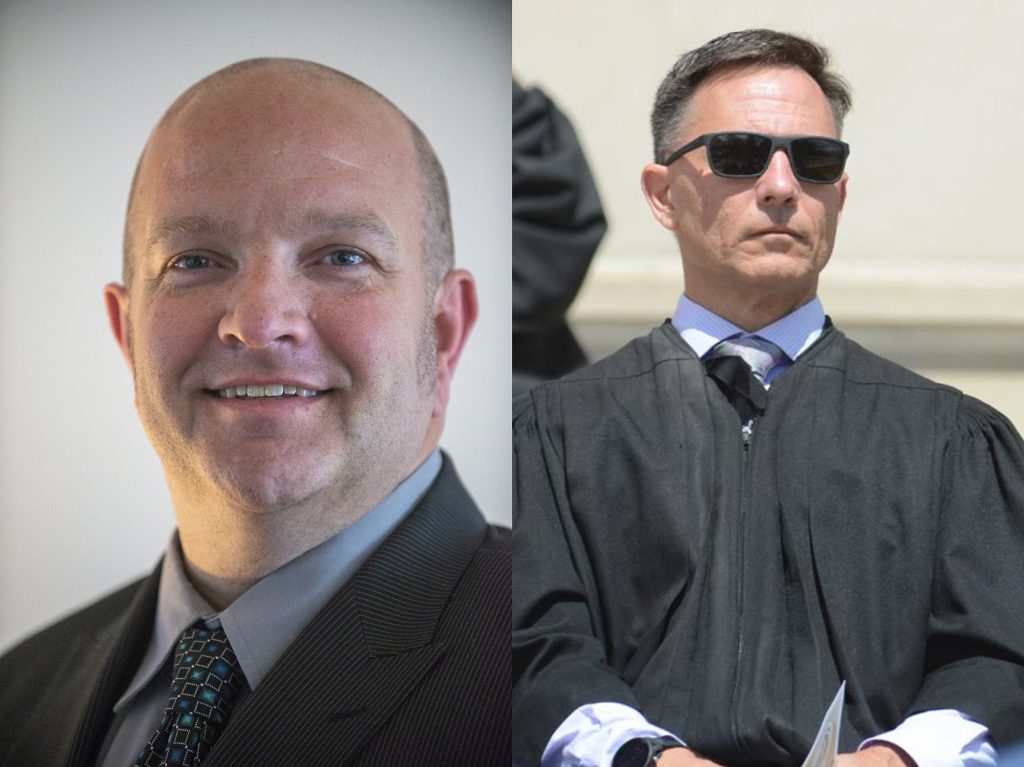
(Photos by Kevin Mathewson, Kenosha County Eye
KENOSHA, Wis. — If someone told you that a journalist was writing stories critical of a judge, exposing embarrassing information about that judge, and then found himself the subject of multiple law-enforcement complaints apparently aimed at having him criminally prosecuted and jailed, you might assume the story was unfolding in a third-world country under a dictatorship — not in the United States. But according to records reviewed by Kenosha County Eye, that controversy is playing out right here in Kenosha County.
Kenosha County Circuit Court Judge Chad Kerkman (D) first reported Kenosha County Eye editor Kevin Mathewson to the Kenosha County Sheriff’s Office on Sept. 12, 2025, classifying Mathewson’s critical reporting on him as “threats,” according to law-enforcement records reviewed by Kenosha County Eye. Despite the serious classification, the Sheriff’s Office apparently took no law-enforcement action against Mathewson, never contacted him for an interview, and never sought criminal charges. Instead, the matter was reportedly discussed with Kenosha County Corporation Counsel, and no action was taken against the journalist. Shortly afterward, Kerkman appears to have escalated the matter to the Wisconsin State Capitol Police, who have now been involved in the dispute for approximately eight months.
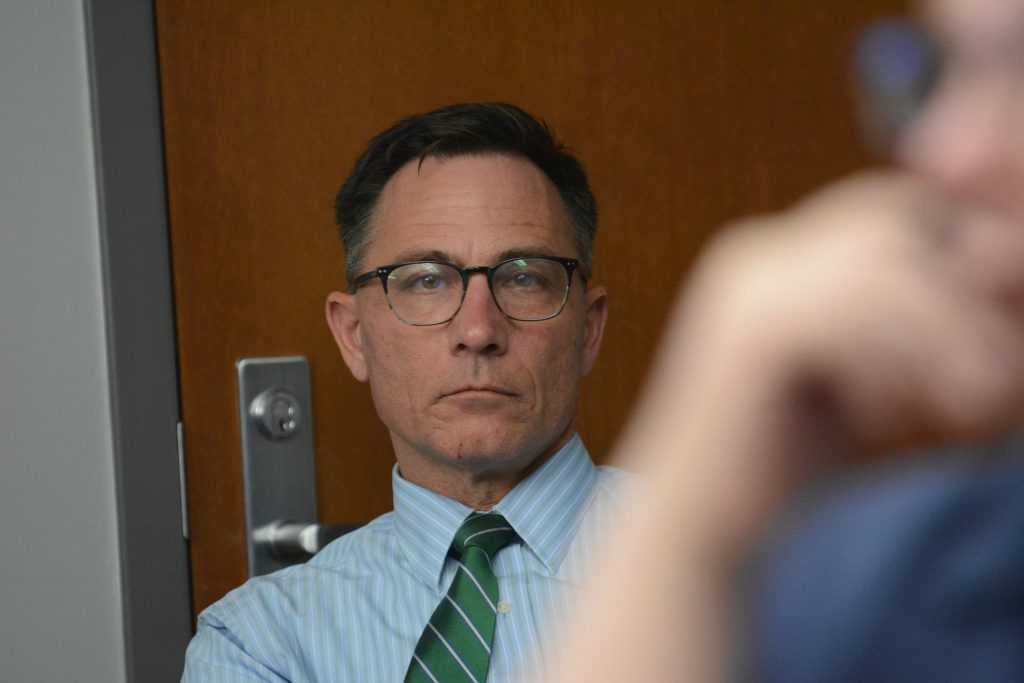
(File Photo by Kevin Mathewson, Kenosha County Eye)
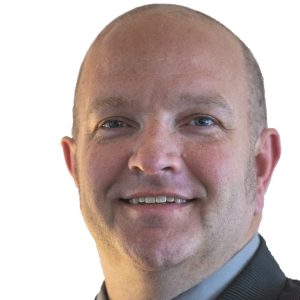
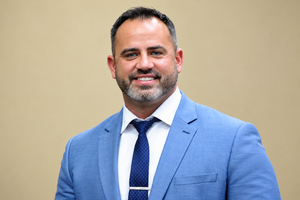
The complaint appears to stem from Mathewson’s critical reporting on Kerkman, including articles criticizing the judge’s courtroom decisions, repeated reversals by the Wisconsin Court of Appeals, Kerkman’s ban on photography in intake court, reporting surrounding felony identity-theft charges filed against the judge’s longtime bailiff, allegations of an inappropriate sexual relationship with a former clerk, Mathewson photographing Kerkman at public meetings, publishing Kerkman’s publicly available campaign registration statement, and photographs Kerkman himself publicly posted on social media with Kenosha County District Attorney Thomas “T. Clair” Binger (D).
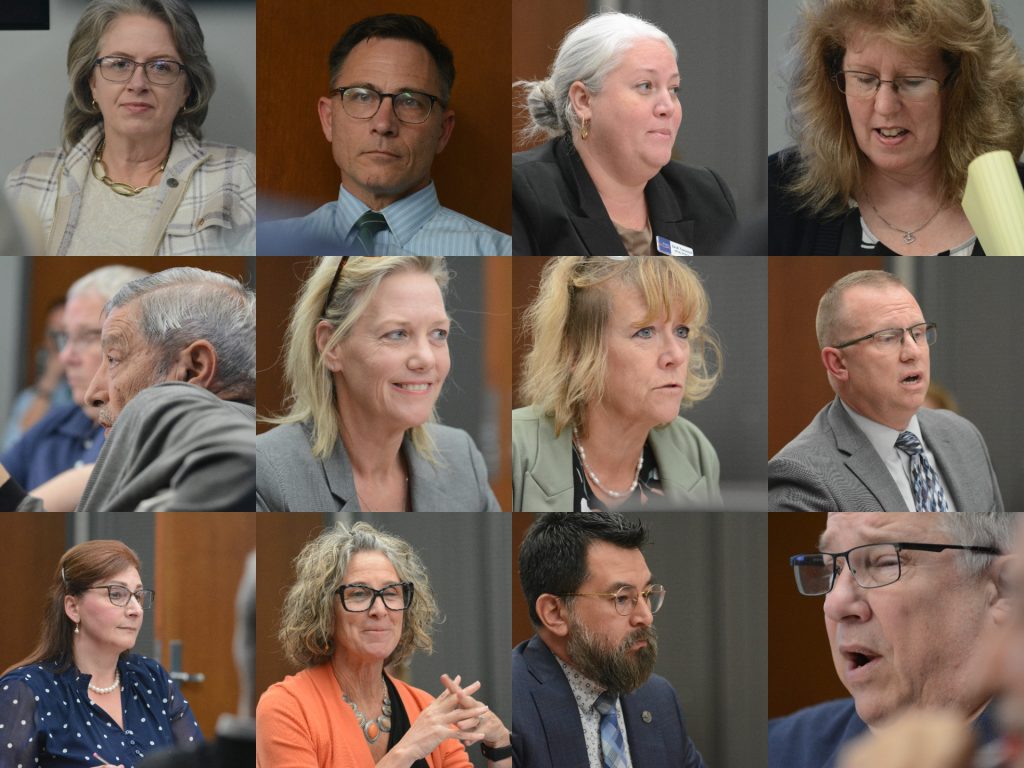
(All Photos by Kevin Mathewson, Kenosha County Eye)
Mathewson believes the timing is not coincidental. Shortly after he filed a federal lawsuit in the Eastern District of Wisconsin challenging Kerkman’s photography ban and courtroom restrictions, the judge allegedly began making complaints to law enforcement agencies.
Although State Capitol Police have apparently been involved behind the scenes for approximately eight months, Mathewson only recently received a direct phone call from a detective with the agency.
“The delay alone speaks volumes,” Mathewson said. “If there was actually a credible criminal threat here — which no one, including Kerkman, believes — law enforcement would have acted immediately, not sit on it for month after month. This looks more like an attempt to weaponize police against a critic than an actual public safety issue. I’d expect this in China, Russia — not here in the USA.”
According to information reviewed by Kenosha County Eye, investigators have examined complaints involving Mathewson publishing critical articles about Kerkman, using publicly available social-media photographs of the judge, photographing the judge at a public meeting, and publishing Kerkman’s campaign registration statement obtained from the State of Wisconsin’s public Sunshine website.
Mathewson said investigators appeared to believe his reporting was intended to improperly influence future judicial rulings, rather than criticize prior decisions already made from the bench.
Mathewson said the reporting in question focused on decisions already made by Kerkman — decisions that many readers and attorneys strongly disagreed with — not attempts to influence future rulings.
Mathewson also rejected what he described as a false narrative that he singularly targeted Kerkman, noting that Kenosha County Eye has published critical reporting involving numerous judges, prosecutors, commissioners and public officials over the years.
“Anyone who follows Kenosha County Eye knows I’ve written dozens of stories casting other judges, prosecutors and law enforcement in an unflattering light — because of their own conduct,” Mathewson said. “The idea that I have some singular obsession with Chad Kerkman is simply not true.”
The detective also reportedly questioned Mathewson’s use of photographs showing Kerkman and Binger embracing socially, including shirtless photos the two men had publicly posted themselves online.
Mathewson maintains that publicly available photographs of elected officials are fair subjects for commentary and scrutiny, particularly when those officials maintain close political and professional relationships with one another. Mathewson noted that Kerkman was closely aligned with numerous local officials who circulated nomination papers during his most recent judicial election campaign, including County Board Supervisors Erin Decker (R) and Gabe Nudo (D), County Executive Samantha Kerkman — the judge’s former spouse — then-Assistant District Attorney Thomas “T. Clair” Binger (D), likely future inmate Andy “Sgt. Hard” Berg, and Court Commissioner Elizabeth Pfeuffer.
Wisconsin’s own judicial ethics rules recognize that judges occupy a unique role and are expected to endure criticism and heightened public examination. The Wisconsin Supreme Court’s commentary to SCR 60.03 states that judges “must expect to be the subject of constant public scrutiny” and accept restrictions and criticism that ordinary citizens may find burdensome. Mathewson said the current situation appears inconsistent with that principle, arguing that criticism of a judge’s public actions should not be treated as a law-enforcement matter. “The Supreme Court is essentially saying judges need to have a thick skin,” Mathewson noted. “Chad’s skin couldn’t be any thinner.”
Investigators also reportedly asked about an article in which Mathewson published Kerkman’s campaign registration statement showing when the judge would next be up for election. Mathewson noted the document was obtained directly from the official Wisconsin Sunshine website and was already publicly accessible through a government source.
Although Mathewson said he was not legally required to remove information obtained through government sources, he voluntarily complied with nearly all requests to redact information from the filing.
The detective additionally questioned Mathewson’s presence at a public meeting attended by Kerkman. Mathewson said he sat in one place during the meeting, photographed numerous public officials in attendance, and never followed Kerkman around the room.
Mathewson said the entire situation appears retaliatory and designed to intimidate him because of his reporting and pending federal litigation.
“This started after I sued him and after I exposed embarrassing things involving his courtroom and his conduct,” Mathewson said. “I report critically on a lot of judges. Anybody who actually reads Kenosha County Eye knows that. The idea that criticism of a public official somehow becomes criminal harassment is absurd.”
Mathewson also pointed to the fact that, despite the “threats” classification and the passage of approximately eight months, law enforcement has still not alleged that he threatened violence against Kerkman or anyone else.
Records reviewed by Kenosha County Eye further show that Kerkman requested deputy bodyguards to escort him to at least two separate Judiciary and Law Committee meetings. In one request, Kerkman specifically asked that a deputy escort him to the administrative building and remain present during the meeting. The deputy bodyguard requests were personally approved by Sheriff David W. Zoerner (D).
The records also show Kerkman coordinated an official courthouse security assessment through the Wisconsin State Capitol Police, conducted at public expense. Emails contained in the records discuss courthouse walkthroughs, judicial security concerns, residential security assessments for judges and their families, panic alarms, escorts and other security-related recommendations. The only tangible security-related change Kenosha County Eye has been made aware of following the assessment is that Clerk of Courts Rebecca Matoska-Mentink reportedly stopped allowing certain courthouse personnel to bypass the metal detector screening process.
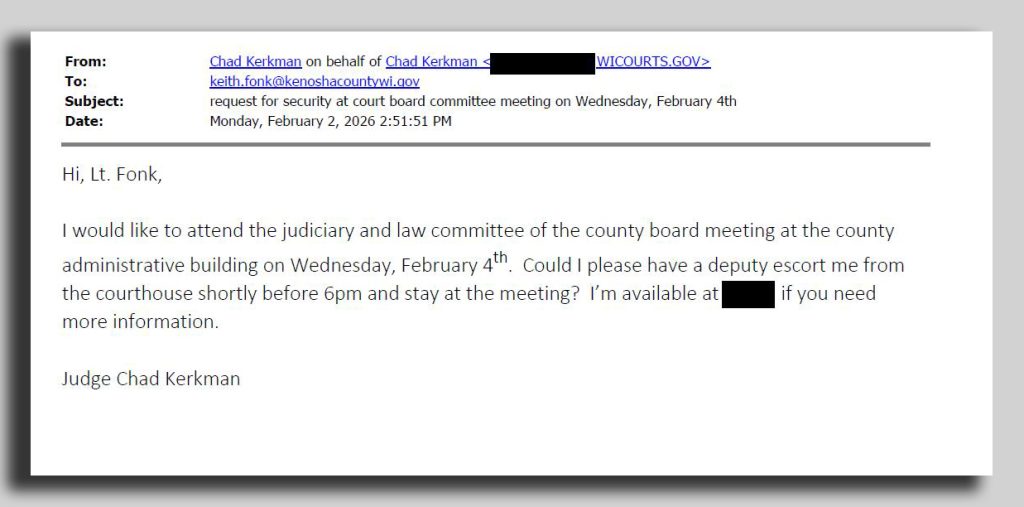
“I’m told that lately Chad is not in his right mind,” Mathewson said. “The fact that he’s asking for deputy bodyguards to committee meetings already filled with law enforcement officers and requesting formal security assessments at the courthouse leaves two possibilities, in my opinion. Either he genuinely believes people are out to harm him and is acting in a paranoid fashion, or he is intentionally trying to gaslight law enforcement into treating political criticism as a public-safety threat in order to silence a critic and punish me for suing him. Either possibility is equally alarming.”
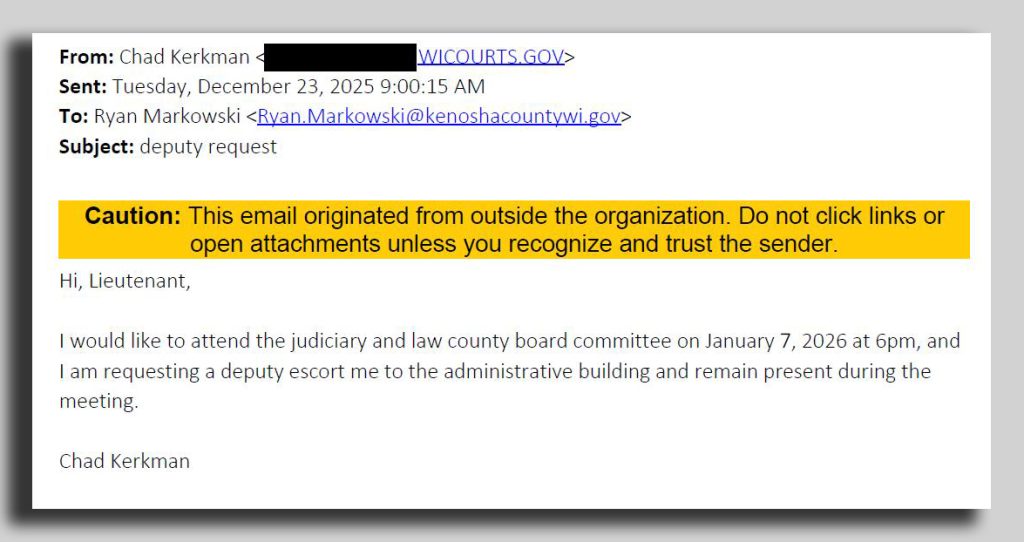
**The above pages were redacted voluntarily, while I have no obligation to so so.






53 Responses
Stay the course Kevin!
Why isn’t this Kerkman dude arrested for making false police reports ????
He is spooked.
But Kenosha exposed can openly say they are blackmailing judges and sleeping with them. And they are destroying evidence for her, and that’s ok?????
In this case, the mischievous and morally obscure husband is taking a different approach: instead of attacking everyone in sight, he is trying to do damage control and remove his DNA from the scene.
Wow
Kevin is a vindictive journalist. He doesn’t report the news. He reports attacks on individuals that have made mistakes and taints the judicial process. He is more like a gossip column blogger as you would say in the social media world. I hope someone is able to shut him down people make mistakes and they go through the judicial process to pay their price for what they’ve done, but he likes to expose them and their loved ones and their employers and ruin their entire life for making a mistake that they will pay for in the court of law.
Quit crying, pussy.
His style is his style. He brought transparency to this county and made it clear that crooked officials cannot get away with it so easily. Look at Celebre, the county board member who voted to raise his own salary. Jerkman: I would not want to see a picture of my son in a cabin by the lake; the real question is why anyone would take and post it. Today, crooked officials have a harder time hiding their dirt, because Kevin will sooner or later expose it
You are a libtarded dumocratic moron!
Put your name up coward.
Corruption is endemic in our government.
You are an idiot.
Name: Chad
Last Name: Jerkman
Spouse: T. Claire Banger
Yea! Shut down free speech! That’ll get em!
Kevin , maybe you “accidentally” let us know who made that comment.
Yep like it or not this poster speaks the truth. Kind of getting old. Most of these are hissy fits against certain people all while ignoring the fact that this site has endorsed most of the candidates who have turned out to be shitty.
One to go..
He’s the only guy that represents the people of Kenosha ! He lets freedom Ring!
We heard a lot of talk this past month of recalling elected officials doing behind closed door meetings. If recalls happen Kevin could be our voice with integrity , honestly and God forgive us if we mention a good Christian man keeping these officials in line. Kevin Run for KCE! People respond if you think he would be the voice we need !
Keep up the fight Kevin and don’t let them beat you down buddy!
Redacted memos, employees being sent to spy on others, employees being fired — all because of the hostility of one angry guy toward the rest of the world? This is an era of shame.
Amen!
Anyone reading KCE sees that Kevin Mathewson reports on the activities of local citizens and officials using publicly available reports and pictures and that editorial articles are labeled as such. You may not agree with what an editorial says but they are clearly within the bounds of protected free speech. Accused criminals and alleged crimes are clearly reported as such. Anyone saying otherwise needs to produce the evidence or retract the allegation. It’s not hard to figure this out. It’s a crime in itself to make false reports to the police or other law enforcement. Judges are expected to know that.
The best thing Kenosha voters can do is get rid of BAD Kenosha county judges.
Kerkman doing a Kerkman…..BWA HaHaHaHaHaHaHa!
Don’t forget about his other pal he likes to take shirtless pictures with – Sgt. Hard aka future inmate!
Kerkman IMHO is a corrupt Judge.
I have first hand experience with his legal transgressions since 2020.
https://racinecountycorruption.blogspot.com/search?q=korrupt+kerkman
Don’t forget about his other shirtless picture buddy Sgt. Hard! The future inmate himself!
Chad G. (Gay as Fu*5) Jerkman is just looking for someone to fill the void left by Bingo’s absence. And when I say void, I mean his rectum.
Keep up the attacks Jerkman, your day will come………..
He will not rest until he gets you incarcerated. It is time for you to take this entire story to the news. Look at what he did to Bargain Bill; everyone, including his own peers, knows he has lost his marbles.
Shut Down Kenosha County’s only Free Thinking Press?
Lenin and Stalin did this in the Bolshevik years of the Soviet Union and Hitler did the same with his Brown Shirts in NAZI Germany.
Kenosha County’s Chief Reprobate Judge is approaching the same mindset of the three totalitarian characters mentioned above.
You forgot to mention President Donald J. Trump. He is actively stifling the voice of the free press in our country. I don’t understand why so many people think that is OK. What is the difference between what Kerkman and Trump are both doing?
On a county-issued device, at work? Seriously, you liberals—once Cuba is free, we should send you all there.
Big difference in at least one way….Trump appears to like women.
True, but they are young women, a bit too young.
HaHaHa….it appears you are one of today’s many delusional Brown Shirts….
What you say makes no sense. However, that is understandable. It is difficult to deny that Kerkman is doing the exact same thing as Trump and Trump is doing the exact same thing as the three tyrants that you cite.
Jerkman doesn’t belong to the Brown Shirts; he is a gender traitor. They had a priority and it was imposed Law and Order. Under the Brown Shirt rule, there is no room for individuals like you either, whose brains are being devoured by the liberal worms. Mind my words: Charlie Kirk is our new Horst Wessel.
Shady Sam
Crooked Kerkman
What a pair of incompetence
They should both resign . It’s time for a change , people are sick of them . Maybe they can remarry and move to another state and do us all a favor . This is as nice as I can be. The dishonesty , lack of integrity, and vengeance they have on Kevin and others that challenge them is not very Christian like.
I’ve heard you’re now referred to as “Mr Buttcrack” in the courthouse now
There are going to say you sued them on those other issues after you got wind they’re investigating you.
That accusation you are doing the reporting is to influence their official actions is a real stretch.
If that sticks me telling an incumbent I will vote against you if you dont do something makes us all criminals!
You are right over the target Kevin for this judge to go after you. You are like Nick Shirley exposing the corruption in our judicial system in Kenosha! Keep up the great journalistic reporting! Kenosha News doesn’t do it!
I feel really bad for the kerkman kids.
I don’t
What about Bill’s kids?
Keep up the good work Kevin! We need transparency in a time where it’s all but gone. We should ALL want transparency UNLESS you have something to hide!! These judges in Kenosha are horrible and the public needs to be aware of who they let back on the street only to reoffend again and again.
Did you ignore his advances on you or something? Kevin got himself a stalker..
Don’t stop Kevin
Kevin,
Take the whole mess to the U.S. Attorney: the pressure campaign, the conspiracy against Solis, the first Republican DA to win in a century, the Capitol Police sent to harass you after the local balked, the secret redacted memo, and what they did to Clerk Heather. Michel will have plenty to add. You’ve got more than enough to feed them, and the current head of the bureau is not brainwashed—they will investigate.
Judge Kerkman IMHO is a corrupt POS going back several years
https://racinecountycorruption.blogspot.com/search?q=korrupt+kerkman
I have personally documented his transgressions in law.
Kerkman in IMHO is a corrupt Judge.
I have witnessed many illegal transgressions in his court.
Patterns & Practice of corruption appears evident
https://racinecountycorruption.blogspot.com/search?q=korrupt+kerkman
Kerkman makes dumb decisions and Kevin reports on it. It’s embarrassing so Kerkman wants to force Kevin to stop reporting. It would be simpler solution if Kerkman would quit making stupid and embarrassing decisions.
Kevin, thanks for shining a light on Kenosha’s swamp creatures!
Kerkman looks like an absolute psycho! He doesn’t need a body guard. He needs a straight jacket!
Kerkman is going to keep his eye on you
Gabbo the clown?
Kevin a sincere thanks for caring for our community! This Kerkman name is tainted everywhere you look . Crooked Sam, Racist Randy , clueless Chad . We could go on for days !