



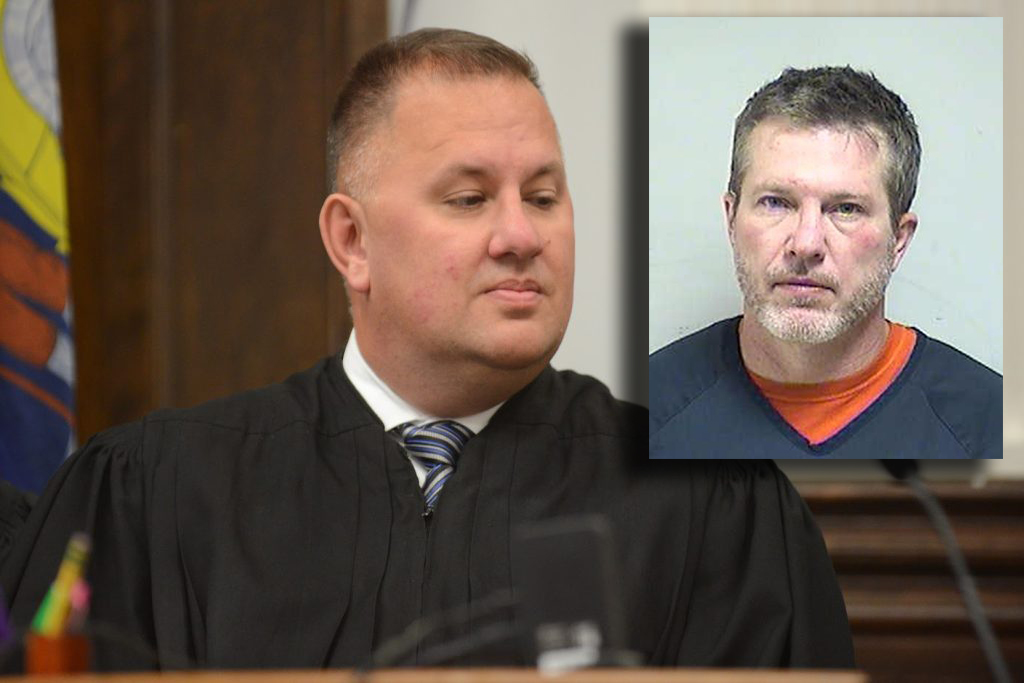
(Photo of Judge, Kevin Mathewson, Kenosha County Eye - Brandes, Kenosha County Sheriff's Office)
KENOSHA, Wis. — Every day in Kenosha County, parents, grandparents, spouses, girlfriends, boyfriends and other loved ones put up thousands of dollars of their own money to get someone out of jail. But posting cash bail comes with significant financial risks. Those who post the money are warned that it may ultimately be used to pay fines, court costs, restitution and other financial obligations. They also risk losing the money if the defendant violates certain court requirements. For someone facing a felony fifth-offense drunken driving charge, which ordinarily carries a mandatory minimum of 18 months of initial confinement upon conviction, those risks can be particularly significant. In a somewhat unusual development Thursday morning, October 8, 2026, Kenosha County Circuit Court Judge Jason Rossell (D) allowed a person who had posted $7,500 cash bail for a repeat OWI defendant with a violent criminal past to get the money back and ordered the defendant taken into custody.

(Kenosha County and Lake County Sheriff's Office)
You must be logged in to view the rest of this article.























8 Responses
Every year, bond money is returned to people who heard the conditions, signed the paper and took responsibility for inmates. They whine and cry after the fact when they can’t find the person or find out they’re breaking bond conditions.
This defeats the whole process. If you pay to get them out, you are responsible for them. If they violate bond, you lose the money you posted.
Many times, the bond money comes from drug dealers who loan it out. Or the inmates own stash. Or a naive Grandma who feels sorry for the inmate. If you held the person paying responsible and refused refunds, many dangerous repeat offenders would stay locked up.
This refund process doesn’t always happen in court. Usually they just complain at Records where it’s paid. Someone in charge (?) approves it.
Is there a way to find out how often bond is refunded? And why they don’t enforce the conditions since the person paying initially agrees that they will lose their money if the inmate reoffends? This should be seen as an official contract.
Send him back to Illinois for parole with conditions to never return to Wisconsin. If only we could.
Many people don’t know that once they’ve posted bond for someone they can retract it and surrender the person. The most surprised person is the one being taken into custody again.
You’d be very surprised at how many do ask and get their money back. Enough people know the system.
Sometimes even lawyers don’t know that. I saw one public defender in shock when the parents of a miscreant told the judge how much trouble they were having controlling him so the judge told them they could surrender him and he would go back in jail. The public defender was arguing that it couldn’t be done. He was wrong, said the judge.
To the first question, it’s not unprecedented for the people who post bonds to get nervous about whether the people they went to bat for are violating bail for which they could lose their bond. State law provides a release valve. They can literally surrender the person who gets taken into custody and they get their money back. Always dicey to post bond for someone because if they get convicted any fine and court costs are deducted from the bond posted before the rest is returned.
Kevin. You write,
“Those who post the (bail) money are warned that it may ultimately be used to pay fines, court costs, restitution and other financial obligations. They also risk losing the money if the defendant violates certain court requirements”
Isn’t posting bail “just” to ensure the person charged shows up in court each time they are called to ?
Why would the money posted for bail (not bond) then be used to pay the penalties associated with this person ?
The person posting bail is just “helping” the accused to be out of jail, not to subsequently pay for those crimes. Seems like a catch 22. Helping a person to continue being outside
With that logic the friend could serve the time in place of the accused.
That used to be the limitation on imposing cash bail in Wisconsin, but voters changed the Constitution in April 2023. Under Article I, Section 8(2), when someone is accused of a qualifying violent crime, courts can now consider the totality of the circumstances—including prior violent convictions, protecting the community from serious harm and preventing witness intimidation—not just whether the defendant will appear in court.
What happens to the deposited money afterward is a separate issue. Wisconsin Statutes §§ 969.02(6) and 969.03(4) direct that, upon conviction, the remaining cash deposit after bond costs goes first toward court-ordered restitution and then toward the judgment, including applicable fines and costs. That applies even when a friend or relative posted the money, which is why the person posting it receives a warning.
You can disagree with that policy, but it is Wisconsin law. Posting bail does not make the friend criminally responsible or require them to serve the defendant’s sentence. It means the money they voluntarily deposited is subject to the legal conditions attached to that deposit.