



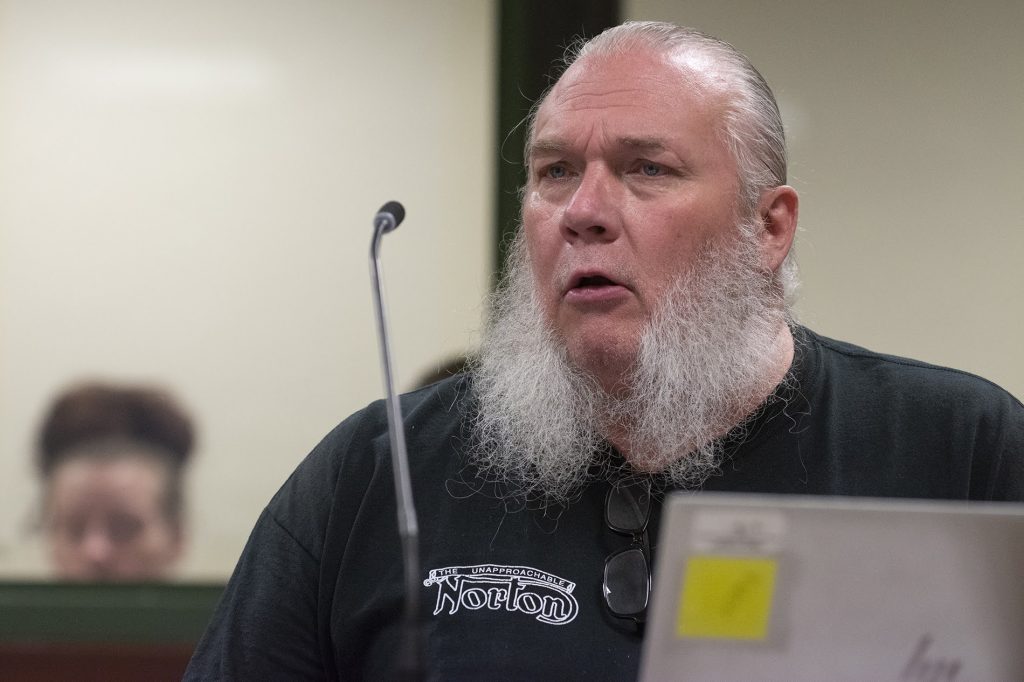
(File Photo by Kevin Mathewson, Kenosha County Eye)
Editor’s Note: This story was modified on September 9, 2026, at 12:55 p.m. after Kenosha County Eye received additional court documents related to this story.
KENOSHA, Wis. — A federal judge has dismissed with prejudice a Mt. Pleasant man’s latest attempt to transform a Kenosha eviction dispute into a sprawling racketeering conspiracy, finding that his lawsuit, which the judge said “appears to have been generated using Artificial Intelligence,” failed to state a legitimate federal claim.
U.S. District Judge Brett H. Ludwig dismissed Patrick Fagan’s case Friday, August 21, after Fagan sued 10 named defendants and five John Does under the federal Racketeer Influenced and Corrupt Organizations Act, commonly known as RICO.
“Fagan’s amended complaint appears to have been generated using Artificial Intelligence and, despite his efforts to plead his way into federal court, the facts alleged confirm that his federal claims are without merit,” Ludwig wrote.
Court records obtained by Kenosha County Eye after the original publication of this story provide additional details about Fagan’s use of artificial intelligence in his court filings.
Fagan Admitted Using AI To Draft Pleadings
During a November 4, 2025 hearing in Kenosha County Circuit Court Case No. 2025SC2971, Judge David Wilk directly asked Fagan whether he used artificial intelligence in preparing his court documents.
Fagan acknowledged asking AI questions, receiving answers and taking some of those answers and editing them using the correct documents, dates, names and spelling. Asked which AI systems he had used, Fagan identified DeepSeek and Grok.
Wilk then summarized Fagan’s explanation, telling him that he had indicated he put information into AI, received information back and then used it “in drafting your pleadings.”
“Some of it, yes. But not — not in its totality. I added a lot of it myself,” Fagan responded.
The following day, November 5, Fagan filed Document 71 in the same case, titled “Supplemental Notice of AI Compliance and Objection to Enforceability of Local Rule CR 02-12.”
In that filing, Fagan disclosed that he used DeepSeek “as a legal assistant and research tool in the preparation of certain filings in this matter.” He said his uses of AI included “legal research, brainstorming arguments, drafting textual content, checking for clarity, and formatting citations.”
Fagan also said his disclosure was intended to cover prior filings in which AI assistance had been used, “including but not limited to all motions, briefs, and affidavits filed to date.”
The court records therefore establish that Fagan used AI for more than simple spelling or formatting. He acknowledged using AI-generated material in drafting pleadings, and his own written disclosure specifically identifies brainstorming arguments and drafting textual content among the ways he used the technology.
Fagan’s cases have also generated an enormous volume of court filings, totaling hundreds of docket entries and thousands of pages. His acknowledged use of AI to assist with motions, briefs, affidavits and other filings occurred amid that extraordinary volume of litigation.
Eviction Dispute Explodes Into Years Of Litigation
The litigation began after Fagan sold a commercial building in the 1900 block of 53rd Street in Kenosha for $115,000 and remained there as a tenant. When the purchaser eventually sought to evict him, what should have been a relatively routine eviction case exploded into years of litigation in state and federal courts.
Fagan also filed a separate Kenosha County Circuit Court action against people and businesses connected to the purchase. Kenosha County Circuit Court Judge Angelina Gabriele dismissed that lawsuit.
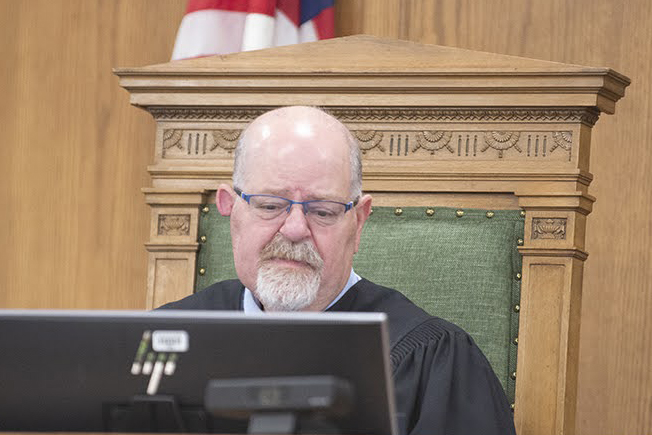
(File Photo by Kevin Mathewson, Kenosha County Eye)
The original eviction was handled by Kenosha County Circuit Court Judge David P. Wilk (D), who granted the eviction but stayed its enforcement, allowing Fagan to remain at the property for many additional months.
Wilk failed to initially require Fagan to post an appropriate bond or maintain insurance on the building during the stay, even after evidence was presented alleging that Fagan had forged an insurance card. Those failures left the property’s owner carrying substantial financial and liability risks after Wilk had already determined that the owner was legally entitled to possession.
The newly obtained transcript also shows that Wilk questioned Fagan about his AI use and instructed him that future filings needed to comply with the court’s AI-disclosure requirements. Wilk told Fagan that future pleadings had to disclose the use of AI, identify the program used and describe how it was used. Fagan twice responded, “Yes, sir.”
Fagan argued that the purchaser could not legally own the building because it was an out-of-state company that had not registered to conduct business in Wisconsin. The Kenosha County court rejected that argument, and the Wisconsin Court of Appeals later explained that Wisconsin law permits a foreign limited liability company to enter contracts and own property despite that registration issue.
Fagan nevertheless repackaged the underlying dispute as a federal RICO case, alleging that the defendants formed a criminal enterprise and committed mail and wire fraud.
Federal Judge Finds Claims Without Merit
Ludwig found no such enterprise. The federal judge concluded that Fagan’s allegations concerned a single property transaction, not an organized criminal operation or continuing pattern of racketeering activity.
Some of Fagan’s alleged examples of wire fraud were ordinary communications necessary to complete the property sale. Others involved a roofing company having a website, receiving online reviews and listing the property as a business location.
“There is nothing connecting many of the disparate defendants besides their alleged involvement in this sale,” Ludwig wrote.
Fagan did not substantively answer the defendants’ motions to dismiss, according to Ludwig.
“Fagan has not responded to the substance of either pending motion to dismiss. Instead, he has filed a series of procedural motions,” Ludwig wrote.
Ludwig didn’t simply dispose of the case because Fagan failed to respond. The judge expressly went on to consider whether Fagan had stated viable federal claims, writing that “waiver aside,” the defendants were correct that Fagan’s amended complaint failed to state a federal claim.
Ludwig also rejected Fagan’s efforts to disqualify opposing counsel, expressly calling one of Fagan’s assertions “frivolous,” and determined that allowing Fagan another opportunity to amend his complaint would be futile.
The federal case was dismissed with prejudice.
Fagan Continues Filing After Dismissal
The filings did not end with Ludwig’s dismissal order.
Fagan subsequently filed a 10-page motion seeking to strike another filing in the already-dismissed case. On August 27, Ludwig denied that motion as moot, noting that the case had already been dismissed and that the document Fagan wanted stricken “was not considered, or even referenced, by the Court in its dismissal Order.”
On September 4, Fagan filed a 21-page Motion for Reconsideration and/or Alteration of Judgment. Among other things, Fagan challenged Ludwig’s RICO analysis, his characterization of the disqualification argument as frivolous, and Ludwig’s reference to artificial intelligence.
Fagan argued that Ludwig’s statement that his amended complaint appeared AI-generated suggested “impermissible bias.” At the same time, Fagan’s reconsideration motion challenges the substance of Ludwig’s RICO analysis and asks the federal judge to reconsider it.
What began as an eviction became a state lawsuit, an appeal, another state-court action and ultimately an alleged federal racketeering conspiracy.
In my view, Ludwig’s eight-page ruling accomplished what Wilk should have done much earlier: cut through an enormous volume of filings, apply the law and bring the federal case to an end.
AI And The Courts
Artificial intelligence can be a useful research and drafting tool. It can also make stupid people sound smart in court documents, at least temporarily. Polished language, legal citations and a confident tone can conceal the fact that the person filing a document does not understand the law or that the arguments themselves are nonsensical.
Fagan is not the only local litigant who has used AI in preparing large quantities of court material. Mathiew Fox and Michael Rizzo, a former Kenosha police officer and former Kenosha County Sheriff’s Office deputy, are two other examples of litigants whose cases have generated hundreds of pages of material involving artificial intelligence.
Kenosha County Circuit Court has a local rule that does not prohibit artificial intelligence but requires litigants to disclose its use. The newly obtained transcript establishes that Wilk specifically instructed Fagan about that disclosure requirement and that Fagan subsequently filed a written disclosure detailing his AI use.
The issue is therefore no longer whether Fagan used AI in preparing legal filings. His testimony and his own written court filing establish that he did. The more meaningful question is how extensively AI contributed to the extraordinary volume of material he filed, and whether courts can effectively manage litigants who use the technology to produce legal material at a pace and volume that would have been difficult to achieve without it.

























3 Responses
Good lord shave that crap!!!!
This guy is the biggest scam in history lol
The Kenosha court’s are pay to play, almost as bad as Racine courts where shysters thrive with the corrupt judges.