




KENOSHA, Wis. — Just months after voters rejected a $115 million referendum, Kenosha Unified School District officials are already preparing to ask taxpayers for more money—this time potentially as soon as November.

During the Tuesday, April 28, 2026 school board meeting, Superintendent Dr. Jeffrey Weiss made the district’s intentions clear.

“What we’re hoping to get from the board… is a direction on whether or not we should be pursuing an operational referendum for November,” Weiss said.
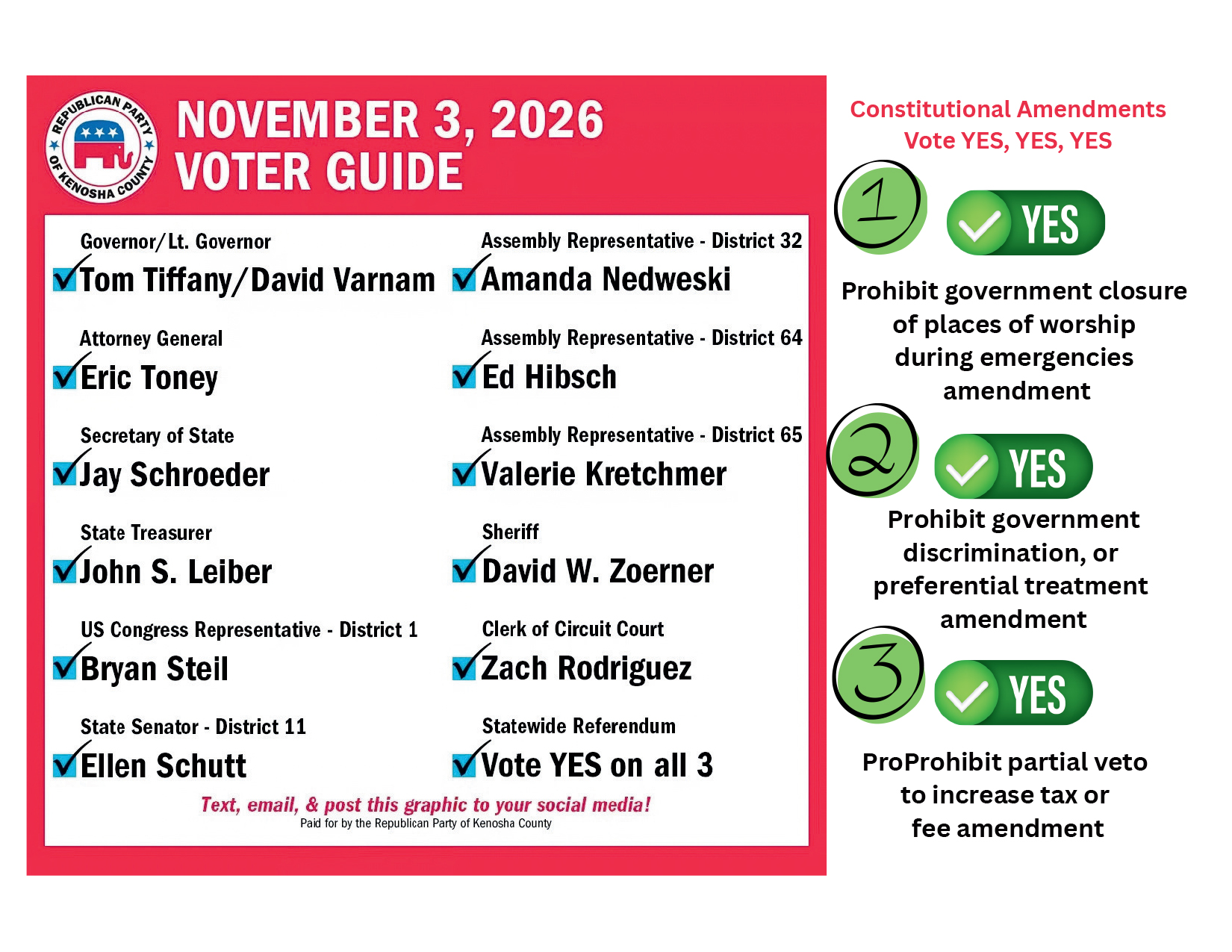

Weiss tied the renewed push directly to the district’s current financial situation.

“I think we’re beginning to see… in the budget and some of our budget realities,” he said.

The Kenosha Unified School Board currently holds a supermajority of Democrats, and insiders tell Kenosha County Eye it is “almost without question” that the board will ultimately vote to send another referendum to voters this fall.

“It seems like they’re just going to keep trying until it passes,” one KUSD insider said.

Chief Financial Officer Tarik Hamdan underscored the district’s financial outlook during the same meeting, pointing to declining enrollment and limited revenue growth.

“We know that our possible revenue limit increase is going to be stuck at $325 per pupil… We also know that our enrollment is going to continuously decline. We don’t see any relief in sight,” Hamdan said.
The renewed push for a referendum comes despite what many viewed as a clear message from voters in February 2025, when the $115 million proposal was voted down in a district widely considered to lean heavily Democratic. The rejection was seen by many as a rebuke—not just of the referendum itself—but of the district’s spending priorities and leadership.
At the same time, many taxpayers are still asking a fundamental question: where did all the savings go?
The district’s “right-sizing” plan closed multiple schools, and in some cases, buildings that had recently received hundreds of thousands of dollars in repairs were torn down. Critics across the community have called that decision wasteful, with some describing it as the kind of thing “only the government would do.”
Despite those closures and cuts, the district is again signaling it needs millions more from taxpayers.
Frustration over that disconnect continues to grow, particularly among staff.
“There’s too many chiefs and not enough Indians,” one teacher told Kenosha County Eye, pointing to what they described as a bloated administrative structure.
For many residents, the situation raises serious questions about accountability. Voters rejected a nine-figure referendum less than a year ago, yet district leadership is already preparing to return to the ballot with another request.
While no formal vote has been taken yet, the direction appears clear. The board is expected to decide in the coming months whether to place a new referendum on the November ballot—setting up another high-stakes showdown between KUSD leadership and taxpayers.





















35 Responses
With the amount of groomers and criminals KUSD hires they should be shutdown not begging for more money! KUSD is a fucken scam
Its everywhere….
EVERYWHERE in KUSD!
Lost a lot of good teachers to Illinois after the last referendum failed. Economy sucks. As shady as this board has been, I’ll most likely be voting for the referendum. Teaching isn’t easy. Especially with the lack of support from a large swath of parents. We lost good veteran teachers after the last one failed. I’ll take a closer look once the vote comes closer. Given how crappy the economy is, I’ll feel the tax increase. To me it’s worth it.
How many is “alot”? I teach and have not noticed an exodus.
Are you a KUSD teacher Todd ?
Ummm. It’s NOT the economy. It’s the administration taking, taking, and then taking some more! It’s the scores officially being lowered so kids look like they are getting better scores in their tests, it’s kids graduating with a 4th and 5th grade reading and math level, it’s parents discovering during 2020-2024 how much their kids did NOT get the education they THOUGHT they were getting all those years, it’s parents realizing that educating their kids at home wasn’t as bad as they thought AND they had plenty of support from other people who were doing the same thing!
So. NO. It wasn’t the economy that caused parents to rethink and get educated themselves in how poorly the KUSD education is and no longer wanting them in the public schools
THAT’S why the enrollments went down.
Get rid of Weiss HUGE savings at the top.
Let’s remodel all the schools and then rip them down and build new.
👆👆👆👆👆👆
Homeschool
the money is needed for lawsits.
next we will see a planned parenthood suite of offices at each school
They want more $, we want better results. We’ll show you ours after you show us yours.
For now, a stipend and performance bonuses. Nothing more.
Lose the bloated admin. overhead and get a grip on all the nuts you keep employing. Pay more for your own healthcare; you know, like us mortals do.
KUSD spending will increase property taxes and make home ownership impossible for the working class and retirees.
Of course those running the School Board and members of the teacher’s Union could care less.
Start from the top and work your way to the bottom very top-heavy with a lot of people being paid a lot of money for doing nothing . A lot of made up jobs Vote NO
Kevin, do you have the ability to show the salaries of the administrators down through the teachers aids?
https://kenoshacountyeye.com/2024/05/08/kenosha-unified-administrators-salaries/
And THAT article was posted 2 years ago! Probably need to ADD another 3-5% since then!
This is from a Story here in February 2025.
These obviously are not current salaries but they are probably close
https://kenoshacountyeye.com/2025/02/16/introducing-the-kenosha-county-salary-search-tool/
I hope everyone did notice the significant rise in property taxes , all for KUSD.
Yep… got my notice yesterday. It says because of insurance rate rise or taxes so I called. And lone behold it was for a tax increase of some sort…
They say they are looking at the Fall election.
Schools typically run referendum votes in the spring. Why the change ? Let’s look at it.
Last one in Kenosha that is talked about here not only was in the spring but in the spring Primary not in the General election in April.
Schools “apparently” can choose when to come to the voters for a referendum.
https://www.kenoshacountywi.gov/DocumentCenter/View/22178/KUSD-NOTICE-OF-REFERENDUM-2-18-25
Schools can pick any one of four dates.
Spring primary
Spring General
Fall Primary
Fall General
We all know primaries typically get very low turnouts. Spring season also gets even lower turnouts compared to fall election season.
Schools say they need to vote in the spring so they can know what to plan for in the Fall.
Those arguments are bogus !!
As a State we allow schools to “pick” when to approach the voters for money.
True every voter should vote in every election throughout the year but they don’t. So schools “date shop” the actual date to ask voters for money.
As mentioned and seen in the link, the last KUSD referendum was in the spring primary. Why ?
That’s the lowest voter turnout expectation of the year. Luckily it failed.
Amanda. Why are schools able to pick any of four dates to ask for money ?
This is, for lack of a better comparison, forum shopping.
This shouldn’t be allowed.
Schools by law should be only allowed to ask for money in the fall general election when voter turnout is the highest of all four opportunities.
I don’t know why we have spring elections at all ?!?
One argument is that there are too many items to vote for if everything is on just one ballot in the Fall. Bullshit !
I’ve gone to the poll and seen just one item in the spring. Depending on which community you live in it’s all over the board on how many items show up.
We as a society allow schools to manipulate the voters by allowing them to pick any one of four dates to ask for money. That’s wrong.
Laws need to be changed.
Eliminate all spring elections completely !!
Have just One primary in late August or early September with the general the first Tuesday in November.
Simple, easy and the most turnout every time.
And no the schools should not be able to put their referendum ask on the primary dates when strategically the turnout is lower. Has to be on one date and one date only. The General election.
First Tuesday in November Period !
Who is Amanda ?
Our Representative in Madison.
Amanda Nedweski
Many stories written about her here.
She can look into these issues in Madison and talk to others there and change these laws.
https://en.wikipedia.org/wiki/Amanda_Nedweski
We’re not going to give them more money. They’re like a lot of families who miss-manage their money and extend their credit card balances.
If anyone gets in the way of teaching our kids and what they need to know to survive then their position needs to be eliminated
Where does it stop? The KUSD portion of my property tax bill accounted for a 25% increase.
It doesnt…the elites say “You will own nothing, and be happy….” Time to start paying attention.
Legalize it and the state would have plenty of $$$.
Illinois is making millions off of high Wisconsinites
HAHAHA! That’s hysterical! Illinois is so broke! Their budgets are waaay under water!
Just what we dont need is more Casinos and legalized genetically altered, mind dumbing , lung polluting garbage!
But the way this world is going , Kenosha will do it…
The last referendum failed and the KUSD portion of the property taxes still skyrocketed. Why do they even need a referendum?
Hows that “voting” working out for ya!
Education in general is an obligate.parasite.
Meaning , it will suck blood until the host is dead.
We are the host. This will never end.
Governor Evers said that $300 plus increase in our taxes every year for the next 400 years was supposed to be for education. This year’s increase alone should be more than enough. Good luck getting any of it, though. I wonder just what he is doing with our money?
Stop giving our money to big tech by buying laptops and useless apps for every student. Test scores and student achievement are declining around the country. Scores have only gone down since laptops were handed out. Pen and paper and text books…probably cheaper and clearly more effective. I will vote no until we start recognizing the problems of these tech policies: privacy concerns, stalled achievement, and wealth transfer to big tech.
What are they going to do with the 34 million they already have in a savings account
From what I understand and heard from the teachers who actually work is the administration is clueless what is actually going on in there schools
They never visit.