



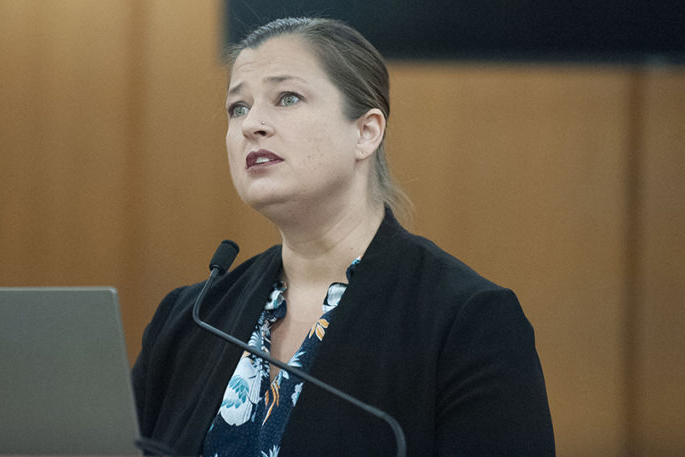
(File Photo by Kevin Mathewson, Kenosha County Eye)
KENOSHA, Wis. — New records obtained by Kenosha County Eye reveal that liberal criminal defense attorney Mackenzie Renner was the subject of two internal investigations during her lengthy career with the Wisconsin State Public Defender’s Office, including one that resulted in an unpaid suspension for violating state work rules prohibiting “Intimidating, interfering with, harassing, demeaning, treating discourteously, or bullying; or using profane abusive language in dealing with others” and “Making false, inaccurate or malicious statements about another person or the employer.” The disciplinary investigation centered on an offensive remark by Renner that included the words “bitch and slave.” Renner later voluntarily demoted herself from her longtime management position and soon thereafter resigned from state service. Although she no longer works for the Public Defender’s Office, Renner continues taking State Public Defender appointments as a private attorney at $100 per hour. Meanwhile, Renner has recently made a point in open court, on at least two occasions heard by KCE, of saying she does not work for controversial Salem attorney Theodore “Ted” Kmiec III or his firm, Kmiec & Noonan, LLC.
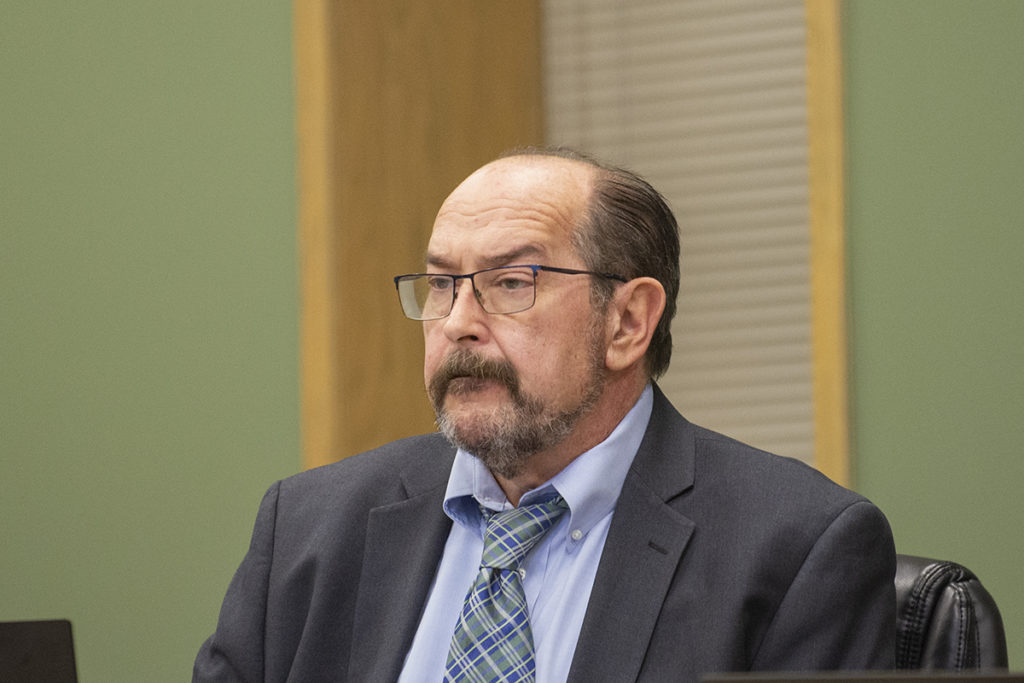
(File Photo by Kevin Mathewson, Kenosha County Eye)
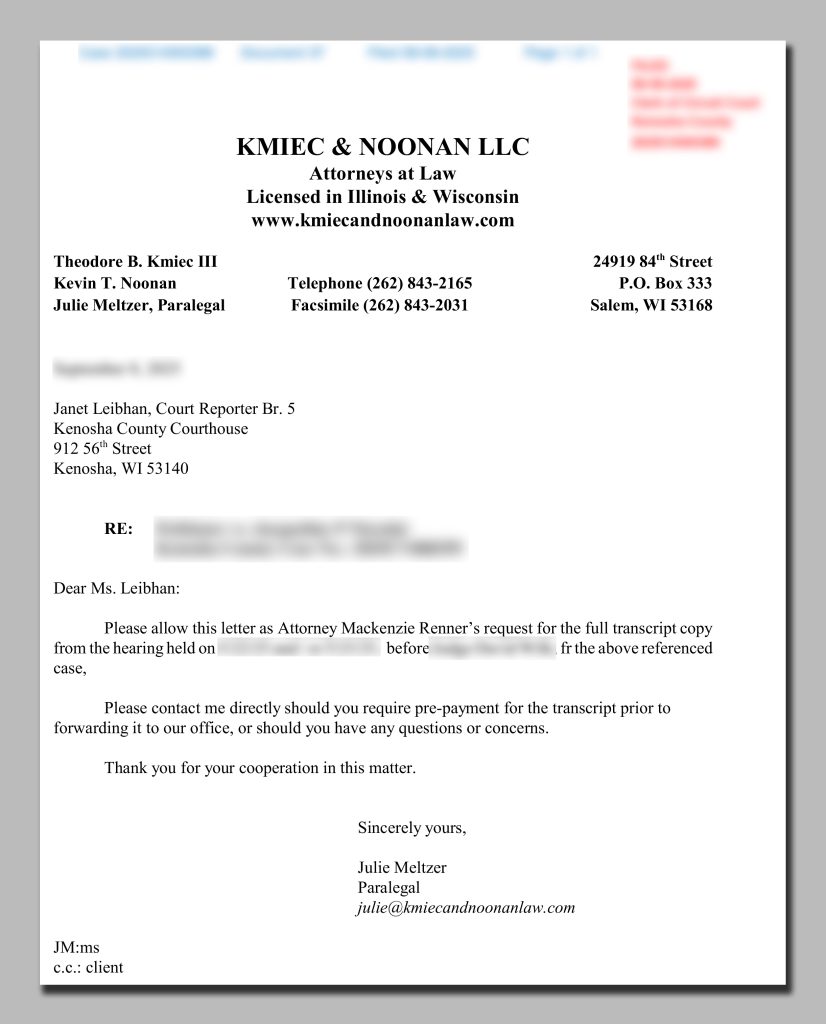
Those courtroom declarations have struck some observers as unusual because KCE previously obtained a letter on official Kmiec & Noonan letterhead in which the firm’s paralegal, Julie Meltzer, expressly made a request on Renner’s behalf for a court transcript. Meltzer instructed the court reporter to contact her directly regarding prepayment before forwarding the transcript “to our office.” The letter did not identify Renner as an attorney with Kmiec & Noonan, and KCE has not obtained documentation establishing that Renner is an employee, partner or member of the firm. Renner’s recent statements in court appear to make that distinction explicit.
The newly obtained records show the disciplinary matter was not simply an informal complaint. The State Public Defender ultimately determined Renner violated both work rules and imposed a one-day suspension without pay. According to the disciplinary letter, another attorney approached Renner for advice concerning a case when Renner responded with a remark containing the words “bitch and slave.” The SPD redacted portions of the statement identifying the people involved and information concerning client representation.
Renner did not completely deny making the remark. During an investigatory meeting, she said she remembered saying something along the lines of transferring the client to someone else involving the word “bitch.” The SPD wasn’t persuaded that the conduct should go without discipline. After considering witness interviews, statements and Renner’s responses during investigatory and pre-disciplinary meetings, the agency determined she violated both work rules and suspended her without pay.
The precise protected status involved is concealed by the SPD’s redactions. In responding to KCE’s records request, however, the agency disclosed that both internal investigations involving Renner concerned alleged offensive comments tied to an individual’s protected status. The records do not disclose whether that protected status involved race, sex, disability or another protected classification, so KCE is not speculating about whom Renner was referring to when she used the words “bitch and slave.”
The discipline presents a notable contrast with Renner’s reputation as a liberal attorney associated with diversity, equity and inclusion principles intended to protect people from derogatory treatment based upon protected characteristics. Whatever Renner intended by the remark, her own employer concluded that her conduct crossed the line and warranted an unpaid suspension.
The records also show that Renner was investigated a second time. The SPD confirmed that investigation began in April 2024 and again involved allegations concerning offensive comments tied to an individual’s protected status. KCE has obtained additional records concerning Renner’s employment history and is continuing to review them.
Less than a year later, Renner effectively demoted herself from the leadership position she had held for more than seven years. In an April 2025 email to SPD leadership titled “Leaving management,” Renner wrote that she no longer wished to work in management. “I realize that I am not happy in this role and it is not a good fit for me,” Renner wrote. She asked whether there were opportunities for her to return to an Assistant State Public Defender role and thanked agency officials in advance for their support of what she herself called her “demotion.”
Renner subsequently resigned from the State Public Defender’s Office. She did not, however, stop taking public defender cases. As a private defense attorney, Renner continues accepting SPD appointments at $100 per hour.
One of Renner’s private State Public Defender clients later made extraordinarily serious accusations about her representation in a court filing. The representation occurred after Renner left her employment with the Public Defender’s Office. The defendant alleged that Renner refused to investigate what he described as exculpatory video evidence, refused to litigate jurisdictional issues, failed to meaningfully pursue pretrial motions despite unresolved discovery concerns, and made a statement on the record about him requesting her withdrawal that he specifically disputed.
The defendant didn’t characterize those issues as ordinary disagreements between a lawyer and client. He argued that Renner’s alleged failures were so serious that they implicated his constitutional right to effective assistance of counsel. He accused her of declining to investigate exculpatory evidence and pursue jurisdictional objections, and alleged that Renner told the court she could not ethically support his position. He argued that under those circumstances, “the adversarial process itself” had broken down and that her alleged performance amounted to a constructive denial of counsel.
In perhaps the most serious portion of the filing, the defendant accused Renner of a cumulative failure to investigate video evidence, failure to compel discovery, failure to litigate jurisdiction and making a “material misstatement to the Court.” He argued that the alleged conduct undermined confidence in the proceedings before his trial had even begun and risked reversible constitutional error. “This is not mere disagreement over tactics,” the defendant wrote. He characterized it instead as a breakdown of the constitutionally required adversarial process. These remain allegations made by Renner’s former client and were not findings by the court. KCE is withholding the defendant’s name.
Questions about Renner’s reliability in court have also followed her. Courthouse insiders have told KCE that Renner has missed court appearances and has been significantly late for others. KCE has independently and personally witnessed Renner miss scheduled court dates on at least two occasions and has observed her arrive very late for other appearances.
Renner is also known among many who regularly frequent the local courthouse for a courtroom style described as unusually dramatic and eccentric. This author has experienced Renner’s litigation style firsthand. Renner represented the opposing party in a relatively minor civil matter involving this author. What should have been a one-day hearing ultimately stretched across four days.
“She just never stops yapping,” KCE Editor Kevin Mathewson said of his experience litigating against Renner. “I prevailed against her in court, as a community college dropout. In my view, she’s a terrible lawyer. I wouldn’t hire her for a parking ticket.”

(File Photo by Kevin Mathewson, Kenosha County Eye)
Renner’s apparent proximity to Kmiec & Noonan has generated additional interest because of the controversies surrounding one of the firm’s namesakes, attorney Theodore “Ted” Kmiec III. Those controversies should be distinguished from the law firm itself and from Kmiec’s law partner, Kevin Noonan. KCE has not reported that Kmiec & Noonan as a law firm engaged in criminal wrongdoing.
Kmiec, however, has been the subject of extensive KCE reporting. In December 2024, the Kenosha County Sheriff’s Office SWAT team executed a search warrant at the Salem residence shared by Kmiec and his adult son, Trenton. According to records previously reviewed by KCE, investigators allegedly discovered drugs in Ted Kmiec’s bedroom, office and other portions of the home where he spent time. Kmiec was never charged with a crime as a result of those discoveries.
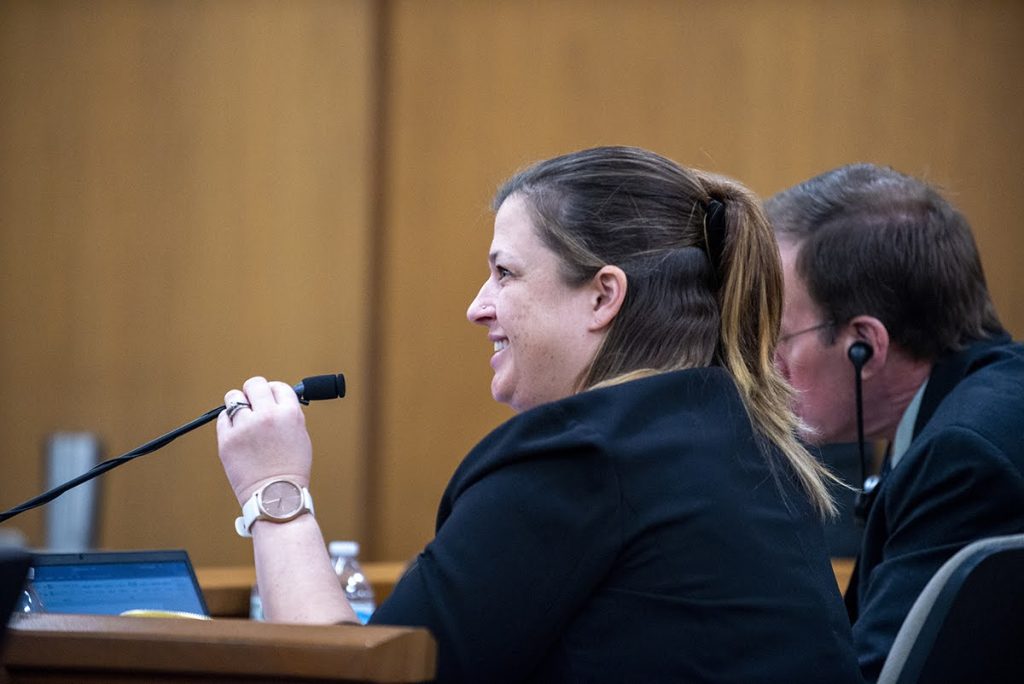
(File Photo by Kevin Mathewson, Kenosha County Eye)
The search was connected to the far more serious criminal investigation of Trenton Kmiec, not allegations that Ted Kmiec committed sexual assault. Trenton was subsequently charged with dozens of felonies involving allegations of child sexual exploitation and other crimes.
The elder Kmiec’s Salem home had already been the scene of another highly publicized tragedy. In 2022, a woman with whom Kmiec was having an affair died of a drug overdose in his bed. Ted Kmiec was not criminally charged in connection with her death.
Kmiec has also faced political and professional controversy. Voters removed him from the Salem Lakes Village Board, and KCE later reported that he was removed from his position as a supplemental court commissioner. His family’s repeated appearances in the criminal justice system and KCE’s reporting about how some of those matters were handled have kept Kmiec in the public spotlight.
It is against that backdrop that Renner’s relationship — whatever its precise nature — with the Kmiec & Noonan office has attracted attention. The documentary evidence establishes that a Kmiec & Noonan paralegal acted on Renner’s behalf, using the firm’s letterhead and directing that arrangements concerning a requested transcript be handled through “our office.” Renner, meanwhile, has stated in open court on at least two recent occasions that she does not work for Kmiec & Noonan.
That may be technically accurate. KCE has not obtained an employment agreement, payroll record or other document establishing that Kmiec & Noonan employs Renner.
But her repeated courtroom distancing from Kmiec, coupled with documented assistance she has received from his law office, has left observers wondering exactly what the professional relationship between Renner and the Salem firm actually is.
















8 Responses
You are funny
My guess is that Renner is not an employee, associate or partner but might have office space and some clerical support in Kmiec’s office. That’s not a particularly unusual arrangement. Not hard to see how she would want to distance herself. Noonan is a fairly middle of the road guy.
Agree. My assumption was she was renting space, but would also potentially bring new business in via referrals. Her business cards do not show a K&N association. But even being in the proximity of Kmiec wasn’t a good look.
she’ll fit in perfectly with the shitshow that is the kenosha judiciary
The more hard Left these Bolshevik Liberal female swing, the uglier they are inside & outside.
There’s no Beauty in any foul mouth Liberal Marxist kuuunnnttt.
Idk, Ozempic seems to be doing her good.
Personally I would not go there, I recently heard about a side effect called Ozempic pu$$y 😱
Did you notice Renner is representing nurse OWI mom (March 2025) in one of the mom’s many pending cases? Renner, your “opposing party”, and OWI nurse mom all seem to be quite a friendly group – sharing representation and damaging social media posts.
Let’s not forget that that kmiec attorney is dating Renner’s assistant that is half his age.