



Note: Explicit Descriptions Below
State of Wisconsin — Wisconsin’s criminal code contains a gap so absurd that it sounds invented. It isn’t. It’s sitting in black and white in Chapter 948 of the Wisconsin Statutes, and as far as this publication can tell, no one in Madison has ever bothered to close it.
Here is the plain-English version.
Under Wis. Stat. § 948.09, an adult who has consensual sexual intercourse with a 16- or 17-year-old — someone below the state’s effective age of consent but above the threshold where the law treats the conduct as child sexual assault — is guilty of a Class A misdemeanor. Maximum penalty: nine months in jail, a $10,000 fine. No mandatory sex offender registration. That’s the law as written, and it applies whether the adult is 19 or 90.
Now consider Wis. Stat. § 948.10, the state’s “exposing genitals to a child” statute. On paper, it exists to punish exhibitionists — the guy who flashes kids at a bus stop. But read literally, it applies to anyone who exposes genitals “for purposes of sexual arousal or sexual gratification” to any person under 18. It carries no age-gap exception for an adult defendant more than four years older than the minor. The penalty: a Class I felony, up to three and a half years.
Put those two statutes side by side and you get a legislative accident with a punchline: the act of intercourse itself is a misdemeanor, but the necessary physical component of that act — a penis being visible to the other party — is a felony one statute over.
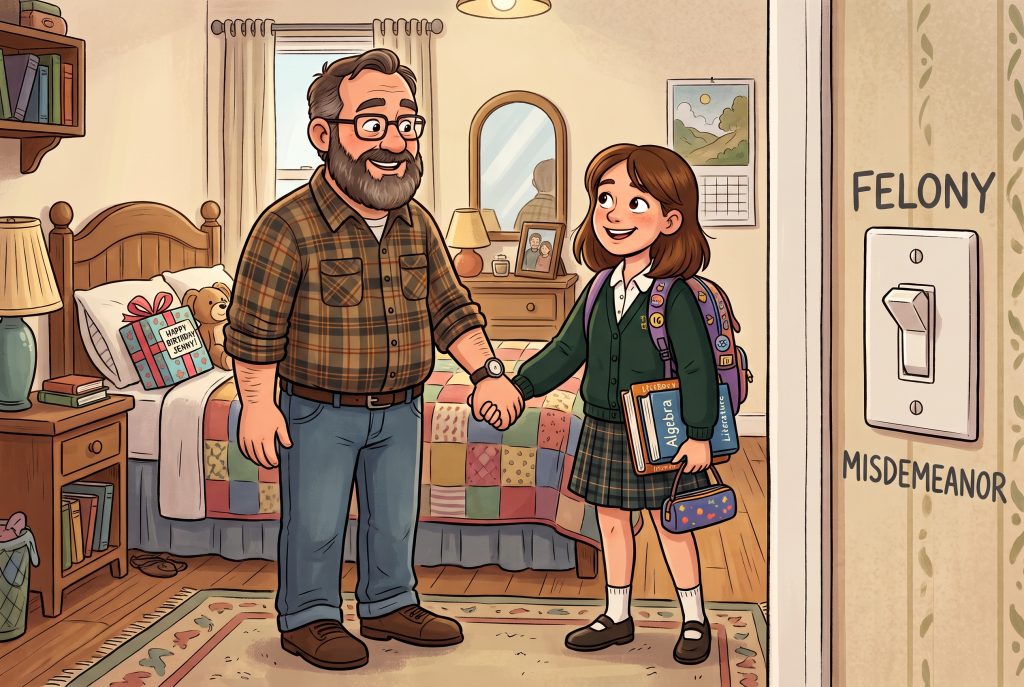
Which raises the obvious, uncomfortable question we posed to test the logic of the code itself: could a 65-year-old man avoid the more serious charge simply by turning off the lights?
The plain language answers the question, and defense attorneys know it. Section 948.10 requires that the defendant “exposes” genitals “to” the minor — you cannot expose someone to something they cannot see. Turn out the lights, and there is no exposure, only contact. This publication has discussed the statute with multiple veteran defense attorneys — lawyers who have practiced for decades — who confirm the same reading independently: turning off the lights defeats the exposure element and takes the felony charge off the table.
This is not a hypothetical. It reflects real charging decisions made in Kenosha County, where this exact gap has shaped how these cases get charged.
How did we get here?
The likely answer is legislative neglect, not legislative intent. Section 948.10’s narrow age-gap exception has sat largely untouched since the 1990s, built for a world of stranger-exhibitionism cases. Section 948.09, by contrast, was amended in 2017 (Act 174) to add a flat “actor must be 19 or older” threshold — a change made on its own track, seemingly without anyone checking whether it left the exposure statute out of step. The result: two statutes governing overlapping conduct, graded in opposite directions, with nobody in the Capitol appearing to notice.
Why it matters
This isn’t an abstract law-school hypothetical. It hands Wisconsin prosecutors unreviewed discretion to turn the exact same encounter into either a nine-month misdemeanor or a three-and-a-half-year felony, depending entirely on how they choose to charge it — and, on the current text, potentially on whether a bedroom light was on. That’s not a policy choice anyone voted for. It’s a drafting failure that has gone unfixed for years because the two statutes are rarely read together.
Wisconsin lawmakers write plenty of bills every session narrowing or expanding sex-offense penalties. Fixing this gap would not require a new idea, a task force, or a hearing full of advocates — only cross-referencing two statutes that were not written to work together, and setting one consistent standard.
Until that happens, the outcome of a case under Wisconsin law can turn, in part, on whether a light was on.














12 Responses
It takes a special kind of political brilliance to pull off a mistake this spectacular. Maybe it’s time we vote for brain cells instead of fan clubs.
Yeah. Because voting is so safe and secure anyway….you know. Illegals voting, ballot harvesting, and homeless being paid to vote….
We live in Wiemar-ica. Its all so fake and gay.
“Weimar-ica” is accurate: Late stage republic-empire decline into economic, political, racial, religious, and today, sexual identification & gender factionalism resulting in a mega-social whirlpool fed by multiple crosscurrents of group resentments notching up into hatreds. It’s happened many times in history when long term economic prosperity incrementally weakens a population’s character that elect empty leaders. However, instead of lamenting the “Weimarican” present condition, recommending you hit the Easy Button to get a future view using AI to quickly learn how the Weimar social rot finally ended when its smartest communitarian capitalist and angriest faction finally said “Enough!”, then took over and applied state of the art industrial engineering to expeditiously erase the stupid, the venal corrupt, the immoral sexually degenerate, and the economic leech get-overs so to reset society into full employment, prosperity, civility, and steady, peaceful social order.
No one is reading an AI created e-novel.
Maybe people just stop being creepy.
Yeah. Because voting is so safe and secure anyway….you know. Illegals voting, ballot harvesting, and homeless being paid to vote….
We live in Wiemar-ica. Its all so fake and gay.
These laws are very sick and twisted
I’m removing all my light bulbs 😎
This law is as idiotic as the “minimum markup law” that we still have on the books.
Nothing like being stuck in the 1800’s…
You’d think it would be a felony to have sex with any woman, the liberals say all women and minorities are not intelligent enough to get an ID.
How do they know what a woman is?
These lawmakers probably started their careers on the KUSD Board.