



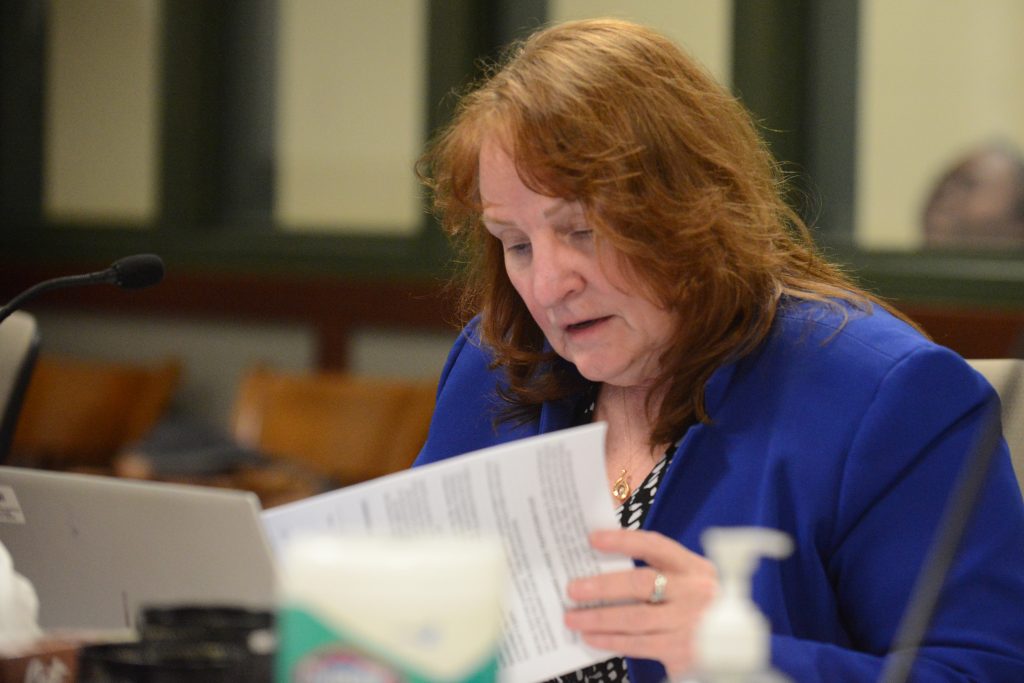
(File Photo by Kevin Mathewson, Kenosha County Eye)
KENOSHA, Wis. — Assistant District Attorney Patricia Riley on Monday lost a Child in Need of Protection or Services (CHIPS) jury trial — a type of civil child-welfare case that legal observers say is among the most difficult for prosecutors to lose — as renewed scrutiny focuses on her conduct in and near the courtroom and her disciplinary history.
A CHIPS case is filed under Wisconsin’s Children’s Code when the State alleges that a child has been abused, neglected, abandoned, or otherwise requires court intervention for protection or services. Unlike criminal cases, CHIPS proceedings are civil matters. However, the stakes are high. If the State prevails, a judge can enter dispositional orders that may remove children from their parents’ custody, impose strict conditions, or ultimately lead to termination of parental rights.
Retired Kenosha County Circuit Court Judge Bruce E. Schroeder — widely known as “America’s Judge” — has often underscored the gravity of such proceedings, observing in substance that few powers exercised by a court are more consequential than separating a child from his or her parents. The authority to remove a child from the home, he has said, stands among the most serious decisions a judge can make. It is against that backdrop that CHIPS trials unfold.
Because CHIPS cases typically rely on extensive investigations, social services documentation, and expert testimony, verdicts against the State are considered relatively uncommon by attorneys familiar with such matters.
In this case, the parents or guardians were represented by long-time Kenosha attorney Terry W. Rose. Kenosha County Eye contacted Rose regarding the matter. He declined comment.
Multiple courtroom observers told Kenosha County Eye that prior to trial, Riley attempted to pressure the parents into signing a consent decree — a legally recognized option in CHIPS cases that allows a family to admit certain allegations or stipulate to court supervision without proceeding to a full adjudication trial. A consent decree can suspend formal proceedings while the family complies with court-ordered conditions, often for up to a year. If successful, the petition may ultimately be dismissed.
According to those observers, Riley allegedly warned the parents that proceeding to trial would be costly and, in what was described as an overly emotional tone, said words to the effect of, “This is going to cost you a lot of money.” Observers characterized the exchange as demeaning and said the parents appeared visibly shaken.
Kenosha County Eye was not present for the entirety of the pretrial discussions and has not independently verified the precise wording. However, several individuals who were in and near the courtroom described the interaction in similar terms.
Beyond Monday’s verdict, Riley’s employment record has drawn attention. Records from the Wisconsin Department of Administration show she received a three-day unpaid suspension in February 2024 for failing to attend a pre-scheduled court appearance and failing to arrange coverage. In June 2024, she was issued an additional five-day unpaid suspension for again missing a pre-scheduled court appearance.
The February 19, 2024 suspension letter, signed by then–Kenosha County District Attorney Michael Graveley, cited violations of State Work Rule #3 — a rule encompassing disobedience, insubordination, inattentiveness, negligence, and failure or refusal to carry out written or verbal assignments, directions, or instructions — along with Work Rule #5 concerning failure to properly report or notify. The June 13, 2024 letter referenced prior discipline and reiterated management’s expectations regarding mandatory court appearances.
To date, Riley appears to be the only assistant district attorney during Graveley’s tenure — both as district attorney and previously as deputy district attorney — to receive unpaid suspensions of this nature.
Riley has also been criticized in and near the courthouse for what some attorneys describe as combative behavior. In one prior incident, observers alleged that she became so confrontational with a court commissioner that she “charged the bench.” No formal finding has been issued regarding that allegation.
Kenosha County Eye sought comment from Riley regarding her disciplinary history. In response, Riley sent a written message that did not substantively address the documented suspensions and instead included what could fairly be described as rambling commentary and quoted scripture. In that same response, she appeared to suggest that Judge Jodi L. Meier was somehow responsible for the discipline imposed upon her.
However, judges do not have the authority to discipline prosecutors. Employment discipline within the District Attorney’s Office rests with the elected district attorney and the State Prosecutors Office — not with members of the judiciary.
The District Attorney’s Office has not issued a public statement regarding Monday’s CHIPS verdict.
For families involved in CHIPS proceedings, jury trials are rare and emotionally charged. The State bears the burden of proving the statutory grounds for intervention. When a jury rejects those allegations, the petition is dismissed, and the family remains intact without court supervision.
Monday’s outcome stands as an uncommon result in a system where the State’s petitions are frequently sustained — and where the power to remove a child from a parent remains one of the most serious tools available to the court.



















7 Responses
would love to see what her response was
maybe this speaks to Kenosha’s crooked and lazy DCFS! maybe they need to be invetigated :/
bingo!!
It’s not just Kenosha DCFS …………….. it’s everywhere.
Is it any wonder no one wants to have kids anymore when something could
happen out of your hands and your kid could fall to one of these lunatics???
Riley is in over her head, she is an IDIOT
Time to retire.
Your best interest would be to get rid of her and that court system they r the ones with the problems